

Why Choose Regulated Advisers for US Expats
- Jan 26
- 16 min read

Moving from America to Europe brings more than just a change of scenery—it means untangling a web of new financial rules that can affect your retirement savings, taxes, and estate plans. When choosing who to trust with your finances abroad, understanding the difference between regulated and unregulated advisers is crucial. A regulated adviser is thoroughly vetted by financial authorities and must maintain high standards of competence and ethics. This introduction helps you protect your wealth as you settle into life overseas.
Table of Contents
Key Takeaways
Point | Details |
Understanding Regulation | Choose a regulated adviser to ensure accountability and adherence to professional standards in cross-border financial advice. |
Consumer Protection | Regulated advisers provide consumer protections, including access to ombudsman services and professional indemnity insurance for client losses. |
Compliance Knowledge | A regulated adviser’s comprehensive understanding of international compliance helps avoid costly tax and legal issues for US expats. |
Fee Transparency | Ensure clear fee structures with regulated advisers to align costs with your financial interests and outcomes. |
Regulated Advisers Explained And Common Myths
When you’re an American moving to Europe, financial advice feels personal. You need someone who understands your 401(k), your cross-border tax situation, and how your US pension interacts with your new home country’s system. This is where regulated advisers matter far more than you might realise. A regulated adviser isn’t just someone with business cards and a confident manner. It’s a professional who has jumped through specific regulatory hoops, maintains ongoing professional standards, and operates under the watchful eye of financial authorities. For US expats especially, this distinction between regulated and unregulated advisers can mean the difference between solid financial planning and costly mistakes that follow you back to America.
Let’s clear up what regulated advisers actually are. Professional standards set and enforced by regulatory bodies require advisers to hold specific qualifications, comply with strict ethical codes, and maintain an annual statement of professional standing demonstrating their competence and knowledge. In the UK, the Financial Conduct Authority (FCA) enforces these standards. In other European countries, equivalent regulators ensure advisers meet baseline requirements. This means your regulated adviser has passed exams, meets continuous education requirements, and can be held accountable if they give you dodgy advice. Unregulated advisers operate in a different world entirely. They might be knowledgeable individuals, but they’re not bound by the same oversight mechanisms. No annual reviews of their competence. No regulatory body to complain to if things go wrong. No obligation to prove they actually understand tax treaties between the US and the UK, or how FATCA affects your savings account.
Now for the myths. The first big one? “All advisers are pretty much the same.” Not true. Regulated financial advice operates within frameworks rooted in financial regulation acts, with specified training requirements, ethical obligations, and accountability mechanisms that unregulated advisers simply don’t face. Another myth: “Only product salespeople need regulation.” Wrong again. Regulation covers the full spectrum of financial advice, from investment recommendations to pension consolidation strategies to estate planning. The third myth creeps in when you think “licensing is optional.” For advisers giving regulated financial advice, it’s absolutely mandatory. You might meet someone brilliant at tax planning who isn’t formally regulated. That doesn’t mean they’re not good. It means they’re operating outside the system that protects you when disputes arise.
Tip professionnel When interviewing advisers, always ask directly: “Which regulator oversees your work, and can you provide your registration number?” A legitimate regulated adviser will answer this question instantly and honestly.
Core Differences: Regulated Vs Unregulated Firms
The gap between regulated and unregulated financial firms is wider than most US expats realise. You might think it’s just paperwork and bureaucracy, but the difference actually affects what happens when something goes wrong with your money. A regulated firm operates under a system designed to protect you. An unregulated firm? You’re largely on your own. For Americans relocating to Europe, this distinction becomes critical when you’re managing complex cross-border finances like pension transfers, investment portfolios spanning two countries, or tax planning that touches both the IRS and your new home’s tax authority.
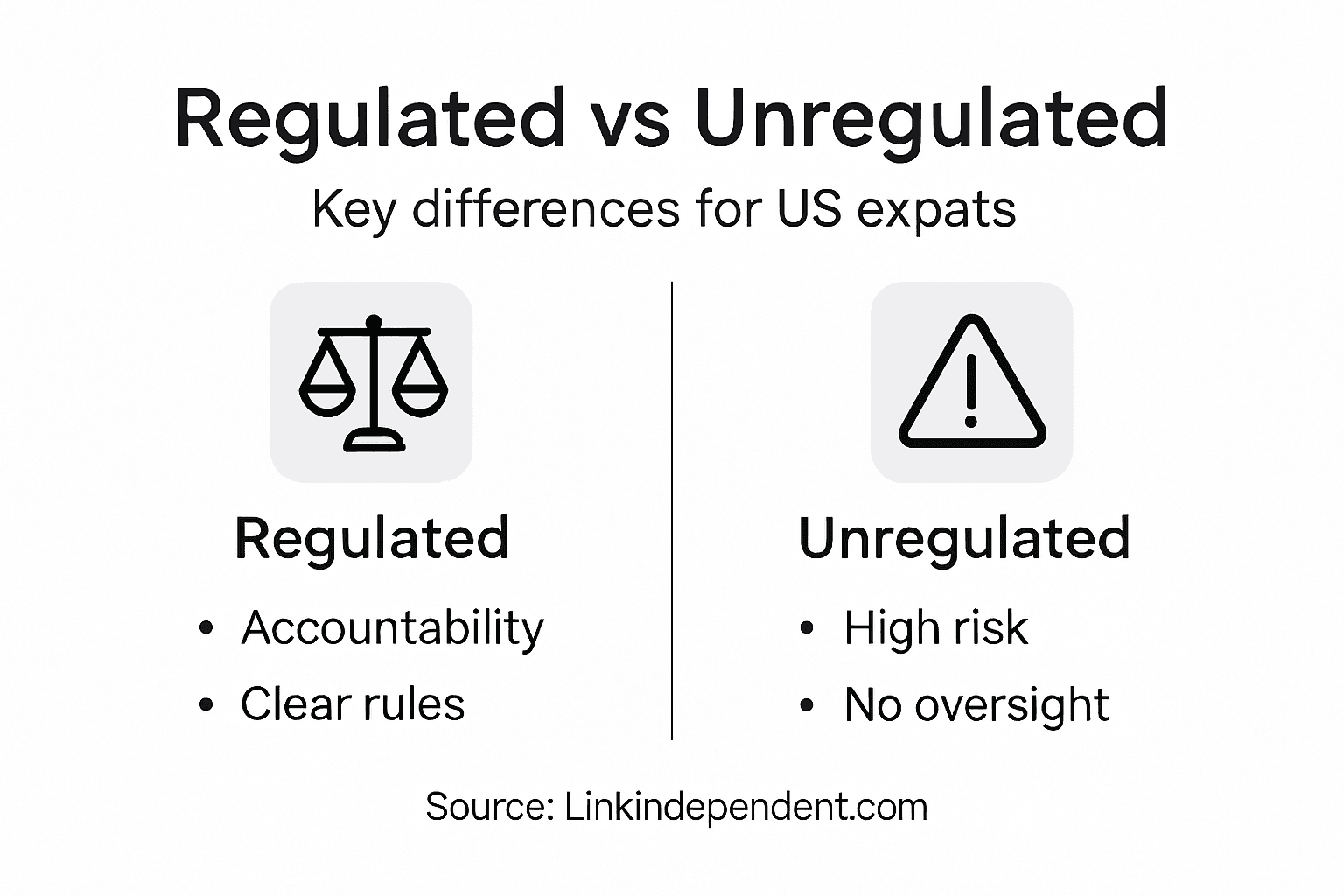
Regulated firms must comply with comprehensive frameworks that cover everything from how they handle your money to how they disclose fees. Unregulated financial entities lack authorisation and supervisory oversight, operating outside the robust regulatory requirements applied to authorised firms within the European Union and beyond. In practical terms, regulated firms in the UK must meet FCA standards, which means they’ve been vetted, they maintain professional indemnity insurance, and they’re subject to regular inspections. Unregulated advisers might be brilliant at what they do, but they’re not backed by any regulatory safety net. They don’t have to prove their qualifications to anyone. They don’t have to carry insurance protecting your assets if they collapse. They don’t have to report their conduct to a watchdog.
Consider what happens if things go wrong. With a regulated firm, you have clear recourse. You can file a complaint with the regulator. You can access the Financial Ombudsman Service if disputes arise. You can potentially recover funds through compensation schemes. With an unregulated provider, your options shrink dramatically. You’re left pursuing legal action at your own expense, which becomes expensive fast when dealing with cross-border disputes. Regulated institutions enforce industry standards protecting consumers and maintaining market integrity, whereas unregulated finance operates without this oversight. This doesn’t mean unregulated firms are automatically dishonest. It simply means the system isn’t built to protect you if they are.
For US expats, the stakes climb higher because your financial life is genuinely complicated. You need someone who understands FATCA reporting, foreign earned income exclusions, tax treaty implications, and how your old 401(k) fits into your new European tax situation. A regulated adviser in the European country where you’ve relocated has passed exams proving they understand these nuances. An unregulated adviser? They might know all this cold, but there’s no independent verification. No regulator has certified their expertise. No body can sanction them if they give you advice that costs you tens of thousands in back taxes.
Professional advice Before hiring any financial adviser, verify their regulatory status directly with the relevant authority in your country rather than simply accepting their word. Ask for their registration number and check it yourself on the regulator’s official register.
Here’s a concise summary of how regulated and unregulated financial advisers compare across key areas:
Aspect | Regulated Adviser | Unregulated Adviser |
Oversight | Governed by financial authorities | No official authority supervision |
Qualifications | Must prove up-to-date credentials | Unverified or self-declared |
Consumer Protection | Access to ombudsman and schemes | Limited or no recourse available |
Fee Transparency | Detailed, mandated disclosures | Fee structures often unclear |
Liability for Mistakes | Insured against client losses | Client bears full legal risk |
Accountability | Subject to regular audits | No external performance review |
Legal Protections And International Compliance
The moment you become an expat, your financial life enters a legal grey zone that most people don’t anticipate. You’re no longer just subject to American tax law. You’re not entirely under European regulations either. You’re caught between two systems, and a single mistake can trigger enforcement actions from either side. This is why working with a regulated adviser becomes a legal necessity, not just a financial preference. Regulated advisers in your host country understand how compliance actually works across borders. They know which rules take precedence, where conflicts arise, and how to structure your finances to satisfy both the IRS and your new home’s tax authority simultaneously.

Let’s talk about what compliance actually protects you from. When you work with an unregulated adviser who doesn’t understand the complexities of cross-border finances, you risk exposure to unwitting violations. Maybe they don’t file the right forms with the IRS. Maybe they miss FATCA reporting requirements. Maybe they structure your investments in a way that triggers unexpected tax consequences in both countries. A regulated adviser carries professional indemnity insurance and operates under compliance frameworks that force them to stay current with regulations. U.S. financial regulations for foreign wealth managers involve federal and state laws, licensing requirements, and marketing restrictions that create specific legal obligations. An adviser who isn’t regulated doesn’t have skin in the game if things go wrong. A regulated adviser does. Their insurance covers mistakes. Their regulator monitors their conduct. Their compliance officer keeps them informed about regulatory changes that affect your accounts.
The legal protections extend beyond just tax compliance. When you transfer retirement funds from the US to Europe, or consolidate pensions across multiple countries, regulatory frameworks protect your money. Regulated firms must segregate client assets from their own, meaning your cash isn’t sitting in their operational account where it could be seized if they face financial difficulty. They must maintain detailed records of transactions, creating an audit trail that protects you if disputes arise. They must comply with anti-money laundering rules, which actually protects you because it prevents your account from being used for illicit purposes. Unregulated advisers face no such requirements. Your money could technically be commingled with theirs. Record-keeping might be sporadic. Your financial information could be handled carelessly.
For US expats specifically, international compliance means satisfying multiple regulators simultaneously. You need an adviser who understands not just UK FCA rules or German BaFin standards, but also how these interact with SEC requirements, IRS obligations, and state-level regulations. A regulated adviser has compliance officers who track these overlapping rules. They know when FATCA deadlines collide with local reporting requirements. They understand how treaty provisions affect your tax position. This knowledge prevents expensive mistakes. Working with someone unregulated or only partially qualified in cross-border matters leaves you vulnerable to compliance gaps that could cost you dearly in penalties, back taxes, and interest charges.
Expert tip Request a compliance summary from any adviser you interview, specifically showing how they handle FATCA reporting, FBAR requirements, and coordination with your home country’s tax authority—a regulated adviser will provide this documentation easily.
Cross-Border Advice And Specialist Credentials
Not all financial advisers are created equal, and this becomes painfully obvious the moment you cross an international border. You need someone who understands the peculiar intersection of American and European financial systems, tax treaties, pension regulations, and investment rules that operate differently on each side of the Atlantic. A generalist adviser might be brilliant at helping people manage money within a single country. Cross-border advice requires a different skill set entirely. The adviser needs specific credentials, practical experience with expat finances, and demonstrable knowledge of how multiple regulatory systems actually interact. When you’re deciding between regulated advisers, the differentiator often comes down to specialisation and whether they’ve genuinely solved problems for other US expats in your exact situation.
Specialist credentials matter because they prove an adviser has studied the specific complexities you face. Someone with qualifications in international tax planning has passed exams covering treaty provisions, foreign tax credits, and reporting obligations. Someone certified in cross-border wealth management understands how pensions transfer between countries, how your 401(k) behaves under European law, and what happens to your estate when you die abroad. These credentials aren’t just letters after a name. They represent hundreds of hours of study focused specifically on the problems you’re trying to solve. A regulated adviser serving expats will hold credentials like the Certified Financial Planner (CFP) designation with additional certifications in international financial planning, or the equivalent in their jurisdiction. More importantly, they’ll belong to professional bodies that specialise in expatriate advice rather than general financial planning. When choosing cross-border financial advisers, look for those who’ve specifically built practices around serving Americans abroad rather than advisers who’ve simply added expat clients to their standard service offering.
The best cross-border advisers maintain active memberships in organisations focused on international financial planning. They attend conferences about expatriate tax changes. They subscribe to services tracking modifications in tax treaties between the US and European countries. They belong to networks of specialists in other jurisdictions, meaning if you have a question about Portuguese tax law or Dutch pension rules, they have a colleague they trust to consult. This network becomes invaluable when your situation involves multiple countries. Maybe you’re planning to retire in Spain but you’ve got investment accounts in the UK and a pension that’s still in the United States. A true specialist can coordinate across all three systems. A generalist adviser might handle each piece separately without recognising how they interact, leading to missed opportunities or worse, unintended tax consequences.
When you interview potential advisers, ask specifically about their expat experience. How many US clients do they serve? How many are in your exact situation (retirees, professionals, pension holders)? Have they handled cases involving your home country’s specific tax rules? Can they explain how FATCA reporting works with your new country’s financial transparency requirements? Can they walk you through a scenario where your US 401(k) is consolidated into a European pension product? A specialist will answer these questions confidently with specific examples. They’ll tell you about a recent client situation (respecting confidentiality, of course) that mirrors yours. They’ll explain not just what the rules are, but how they’ve successfully navigated those rules for other expats. That practical experience, backed by proper credentials and regulated status, is what you’re actually paying for.
Insider tip Ask potential advisers to identify at least three professional credentials or certifications specifically related to international financial planning, then verify these qualifications independently rather than accepting their claims at face value.
Fee Structures, Transparency And Client Outcomes
Here’s what most people don’t realise about financial adviser fees: they’re often the thing people discuss least but which affects outcomes most dramatically. A 1 percent fee difference compounds over decades. On a 500,000 pound portfolio over 20 years, that seemingly small difference could mean tens of thousands of pounds less for your retirement. This is why transparency in fees matters desperately for US expats. You need to know exactly what you’re paying, why you’re paying it, and whether that fee structure aligns with your interests or works against them. Regulated advisers in Europe are typically bound by rules requiring them to disclose fees clearly upfront. Unregulated advisers? They might bury fees in small print or bundle them in ways that obscure the real cost of their service.
The fee structures your adviser uses tells you something crucial about their incentives. Advisers are increasingly adopting alternative fee structures beyond traditional assets-under-management models, including flat fees, retainer models, and hourly consulting fees designed to increase transparency and align fees with client needs. A traditional AUM fee of 1 percent might sound straightforward, but it creates a hidden incentive. Your adviser earns more money when your portfolio grows, which sounds aligned until you realise they also earn more money when they encourage you to invest more aggressively than your situation warrants. A flat annual fee or retainer model, by contrast, gives your adviser the same income whether your portfolio grows 3 percent or 8 percent. They benefit when you benefit, but not excessively when you take unnecessary risks. For cross-border situations especially, a fee-only structure often works better than commission-based arrangements because it eliminates the temptation to recommend products that generate higher commissions. A regulated adviser will clearly explain their fee model and justify why it works for your specific situation. An unregulated adviser might be vague, claiming their compensation is “flexible” or “negotiable” without explaining the actual mechanics.
Transparency about fees directly impacts your financial outcomes. When you know precisely what you’re paying and why, you can evaluate whether the service justifies the cost. You can compare advisers meaningfully. You can identify when you’re being overcharged or receiving poor value. Clear communication about fees and service scope influences client satisfaction and financial outcomes, particularly when advisers explain how their compensation aligns with client interests. A good regulated adviser will show you fee examples. They’ll explain what services are included at their standard fee level and what costs extra. They’ll disclose whether they earn anything beyond the stated fee from product providers or other sources. They’ll show you fee comparisons so you understand whether you’re paying market rates. More importantly, they’ll tie their fees to outcomes. If they’re charging you a premium because they specialise in expat finances, they should be able to point to specific value they’ve delivered. Have they saved clients money on taxes through careful planning? Have they helped clients avoid costly mistakes in pension consolidation? Have they coordinated across multiple countries effectively? These are the outcomes that justify fees.
For US expats specifically, fee transparency becomes even more critical because your financial situation involves multiple layers of complexity. You might have accounts in the US, investments in your new European home, pensions spanning both systems, and tax obligations to both the IRS and your new country’s tax authority. An adviser charging a flat 1 percent AUM fee might underestimate the work involved because they’re not accounting for the cross-border complexity. A retainer model often works better because it allows your adviser to charge appropriately for the coordination effort rather than penalising them for the complexity of your situation. Ask any adviser you interview to explain their fee model in writing, showing exactly how much you’ll pay annually based on your projected account balance. Ask what additional fees might apply. Ask how their fee structure compares to others in the market. Most importantly, ask how their fees have changed the outcomes for similar clients. The answer will tell you whether you’re getting value.
Money tip Request a written fee schedule and ask the adviser to model your annual costs using three different portfolio balances (your current amount, plus 25 percent and 50 percent growth) so you can see exactly how fees scale with your wealth.
To help US expats evaluate a potential adviser, consider this checklist of specialist criteria:
Criterion | Why It Matters | Example of Strong Evidence |
Cross-border credentials | Ensures expertise in expat finance | International CFP or equivalent |
Documented compliance process | Demonstrates regulatory awareness | Provides sample compliance summary |
Professional indemnity insurance | Protects clients against losses | Insurer listed in service contract |
Proven expat client experience | Indicates relevant track record | Clear case studies for US expats provided |
Clear, written fee breakdown | Enables fair fee comparison | Fee structure sent in plain English |
Common Risks When Bypassing Regulation
Choosing an unregulated adviser feels like finding a bargain until something goes wrong. Then it feels like stepping off a cliff. The risks aren’t theoretical or distant. They’re immediate and real, especially for US expats managing complex cross-border finances where a single mistake compounds across two tax jurisdictions. An unregulated adviser might be cheaper upfront because they skip compliance costs, professional development, and regulatory oversight. But that savings disappears instantly when they give you advice that costs you thousands in unexpected taxes, missed pension consolidation opportunities, or poorly structured investments. For Americans abroad, the stakes climb higher because your financial situation is inherently complicated. You need someone whose competence has been independently verified, whose conduct is monitored, and who bears professional liability if they cause you financial harm.
One of the most insidious risks is that unregulated advisers can operate indefinitely even after causing harm to previous clients. Financial advisors often circumvent regulations by shifting between regulatory regimes, moving from federally regulated to state-regulated roles or disappearing entirely into the unregulated space. This regulatory leakage means a disciplined adviser can simply move jurisdictions and continue operating with diminished oversight. Without regulation, there’s no central database of adviser misconduct. There’s no shared warning system. There’s no way for you to discover that the adviser you’re considering was previously barred from operating in another country for unethical conduct. A regulated adviser’s disciplinary record is public. You can check it. An unregulated adviser’s past remains invisible. You’re essentially trusting someone’s word about their own background.
Consider what happens when an unregulated adviser makes a costly mistake with your money. A regulated adviser carries professional indemnity insurance. If they negligently advise you to invest in something unsuitable and you lose money, you can file a claim against their insurance. You have a real chance of recovering your losses. An unregulated adviser? You’d need to pursue legal action on your own, hiring a lawyer at significant expense. You’d have to prove negligence. You’d have to navigate a court case potentially spanning multiple countries. By the time you’ve spent 20,000 pounds on legal fees fighting over 50,000 pounds in losses, the mathematics make giving up the only rational choice. The unregulated adviser knows this. It’s why they often operate with minimal concern for client harm. The barrier to recourse is so high that few clients pursue it.
For US expats specifically, the cross-border complexity amplifies every risk. An unregulated adviser might not understand FATCA reporting properly, leaving you exposed to IRS penalties. They might consolidate your 401(k) into a European product without recognising the tax treaty implications, costing you years of compounded tax inefficiency. They might not know how US citizens’ foreign bank accounts are treated differently than European residents’ accounts, leading to reporting mistakes. They might manage your estate planning without understanding how your will is treated differently in your home country versus the US, potentially leaving your heirs fighting over which law applies. These aren’t rare edge cases. They’re predictable problems that arise from the complexity of cross-border finances. A regulated adviser specialising in expat advice has studied these scenarios. An unregulated adviser is essentially learning on your dime, and when their learning proves costly, you have no recourse.
The regulatory framework also protects you through ongoing monitoring. A regulated adviser is subject to regular compliance examinations. Their client complaint ratio is tracked. If they consistently generate complaints, their regulator investigates. They face consequences ranging from warnings to fines to loss of their licence. This surveillance creates accountability. An unregulated adviser faces no such monitoring. They can ignore client complaints, fail to correct errors, or deliberately mishandle client assets with no external consequence beyond potential civil litigation you’d have to fund yourself.
Safety tip Before engaging any adviser, search their name and firm on your country’s financial regulator’s official register (such as the FCA register for UK advisers) and verify their registration number independently rather than trusting documentation they provide.
Secure Your Financial Future with Regulated Advisers Tailored for US Expats
Moving to Europe brings complex challenges in managing pensions, taxes, and investments across borders. This article highlights why working with a regulated adviser who understands FATCA, cross-border tax treaties, and international compliance is critical for US Expats. Avoid costly mistakes that can arise from unregulated advice by choosing a professional who holds verified credentials and operates under strict regulatory oversight. Your financial security depends on transparent fee structures, professional indemnity insurance, and advisers accountable to recognised authorities.
At Linkindependent.com, we specialise in connecting US Expats with licensed financial advisers who fully comprehend the complexities of your cross-border finances. Our personalised three-step process ensures you are matched only with regulated experts experienced in handling 401(k) transfers, pension consolidation, and tax planning between America and Europe. We prioritise transparency and compliance so you have confidence your adviser is trustworthy, fully compliant, and has your best interests at heart.

Take control of your international financial journey today by finding a regulated financial adviser who knows exactly how to protect your wealth across borders. Visit Linkindependent.com now to explore how our verified network of specialists can deliver peace of mind and smarter financial strategies specifically for US Expats. Do not leave your future to chance – get matched with your ideal cross-border adviser in minutes.
Frequently Asked Questions
What are the main benefits of working with a regulated adviser for US expats?
Choosing a regulated adviser ensures that you receive professional guidance that adheres to strict ethical and legal standards. They have verified qualifications, ongoing education requirements, and accountability mechanisms that protect your financial interests, especially important for managing complex cross-border finances.
How can I verify if a financial adviser is regulated?
You can verify a financial adviser’s regulatory status by asking for their registration number and checking it against the official register of the relevant regulatory authority. This step confirms whether they are approved and monitored by a governing body.
What risks do US expats face when choosing an unregulated adviser?
Unregulated advisers lack oversight and professional accountability, putting clients at higher risk of costly mistakes. They may give poor advice regarding tax compliance, investment structuring, or cross-border regulations, potentially leading to significant financial losses.
What qualifications should I look for in a regulated adviser for cross-border financial advice?
Look for credentials that specifically relate to international financial planning, such as certifications in cross-border wealth management or international tax planning. These qualifications indicate that the adviser has the necessary expertise to navigate the complexities of your financial situation as a US expat.
Recommended
Comments