

What is HNW wealth management: a guide for cross-border investors
- 3 hours ago
- 10 min read

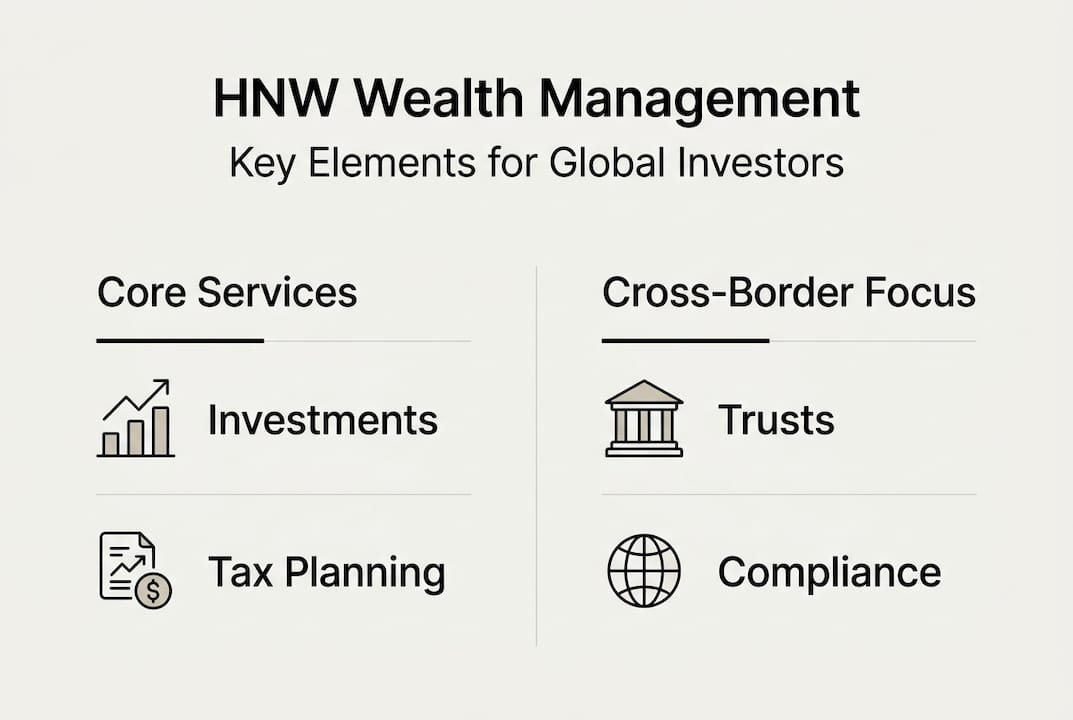
Most people think wealth management is simply picking the right stocks or funds. For high net worth individuals with assets spread across borders, that assumption misses the bigger picture entirely. True HNW wealth management encompasses investment strategy, estate planning, tax optimisation, risk mitigation, and legacy preservation, all coordinated across multiple jurisdictions. When you hold assets in different countries, complexity multiplies exponentially, requiring specialised expertise to navigate conflicting tax codes, regulatory frameworks, and inheritance laws. This guide explains what comprehensive HNW wealth management involves and why it’s essential for protecting and growing your cross-border wealth.
Table of Contents
Key Takeaways
Point | Details |
Integrated HNW framework | High net worth wealth management combines investment strategy, estate planning, tax optimisation, risk management and legacy planning into a coordinated service. |
Cross border complexities | When wealth spans several countries, planning must address residency, tax domicile, trusts and international reporting obligations. |
Governance for ultra HNWIs | Ultra high net worth clients benefit from structured governance and evidence based advice. |
Diversified asset allocation | A well diversified asset mix including alternatives helps manage risk and protect wealth. |
Defining HNW wealth management and its core components
High net worth wealth management refers to comprehensive financial advisory services for individuals with liquid assets exceeding $1 million, focusing on investment management, estate planning, tax optimisation, risk management, and legacy planning. Unlike mass market financial advice, HNW services integrate multiple specialised domains into a cohesive strategy. The distinction matters because wealth at this level creates opportunities and vulnerabilities that standard approaches cannot address.
The core components work together rather than in isolation. Investment management handles portfolio construction, asset allocation, and performance monitoring across public and private markets. Estate planning structures wealth transfer to minimise taxes and ensure your wishes are honoured. Tax optimisation coordinates strategies across jurisdictions to reduce liabilities legally whilst maintaining compliance. Risk management protects against market volatility, currency fluctuations, and unexpected life events. Legacy planning extends beyond financial assets to include philanthropic goals, family governance, and values transmission.
Many HNWIs engage family offices or specialised multi-jurisdictional advisors who coordinate these moving parts. Single-family offices serve one wealthy family exclusively, whilst multi-family offices pool resources across several clients. Both models emphasise integration, ensuring your tax strategy aligns with your estate plan, and your investment approach supports your legacy goals. For those exploring essential wealth planning strategies, understanding this integrated framework is fundamental.
Key service components typically include:
Portfolio construction across equities, fixed income, alternatives, and real assets
Trust and estate structuring for tax efficiency and asset protection
Cross-border tax compliance and reporting (FATCA, CRS, local requirements)
Philanthropic planning including foundations and donor-advised funds
Succession planning for family businesses and intergenerational wealth transfer
Risk mitigation through insurance, hedging, and diversification strategies
Concierge services for banking, legal, and lifestyle needs
The breadth of these services explains why HNW wealth management costs more than robo-advisors or commission-based brokers. You are paying for expertise that prevents expensive mistakes and captures opportunities others miss.
Cross-border complexities: tax, trusts and compliance challenges
When your wealth spans multiple countries, complexity increases exponentially. Each jurisdiction imposes its own tax rules, reporting requirements, and legal frameworks, creating potential conflicts that demand sophisticated planning. For cross-border HNWIs, methodologies emphasise residency and tax domicile optimisation, cross-border trusts, special purpose vehicles (SPVs), offshore holding companies, and compliance with international reporting standards.

Trusts serve as fundamental tools for asset protection and tax planning, but their treatment varies dramatically by jurisdiction. Cook Islands trusts offer robust asset protection against creditors. Nevada and Delaware trusts provide favourable US state tax treatment and privacy. Jersey and Guernsey trusts balance accessibility with regulatory credibility. Qualified Domestic Trusts (QDOTs) allow US citizens married to non-citizens to defer estate taxes. Each structure carries distinct advantages depending on your domicile, citizenship, and asset locations.
Compliance frameworks like FATCA (Foreign Account Tax Compliance Act) and CRS (Common Reporting Standard) require financial institutions worldwide to report account information to tax authorities. These rules aim to prevent tax evasion but create substantial reporting burdens for legitimate cross-border investors. Failure to comply triggers severe penalties, making meticulous record keeping essential. Double taxation treaties provide relief when two countries claim tax jurisdiction over the same income, but navigating treaty provisions requires specialised knowledge.
Edge cases create particular challenges. US citizenship-based taxation traps American expats regardless of residence, forcing them to file US returns and potentially pay US taxes on worldwide income. The UK’s abolition of non-domiciled status increases inheritance tax exposure with a 10-year tail for former non-doms. Forced heirship rules in civil law countries like France (60% reserved for children) and Japan (55%) override testamentary freedom, potentially disrupting your estate plan. Dynamic trust taxation shifts based on beneficiary residence and trust situs, requiring ongoing monitoring.
Offshore structures demand genuine substance to withstand scrutiny. Tax authorities increasingly challenge shell companies lacking real business activity, employees, or decision making in their registered jurisdiction. Permanent establishment rules can trigger corporate tax liability if your offshore company’s activities create sufficient nexus in another country. Multi-bank custody arrangements spread assets across institutions to mitigate counterparty risk, ensuring that one bank’s failure does not jeopardise your entire portfolio.
Common cross-border pitfalls include:
Failing to update structures when changing residence or citizenship
Triggering exit taxes by relocating without proper planning
Creating permanent establishment through remote work or business activities
Ignoring currency risk in multi-currency portfolios
Overlooking succession law conflicts between common law and civil law jurisdictions
Inadequate documentation for cross-border gifts and inheritances
Trust jurisdiction | Key features | Primary advantages | Typical use cases |
Cook Islands | Asset protection trust, 1-2 year creditor lookback | Strongest creditor protection globally | High litigation risk professionals, entrepreneurs |
Delaware | Dynasty trusts, no state income tax on out-of-state beneficiaries | Perpetual trusts, privacy, US jurisdiction | Multi-generational US wealth transfer |
Jersey | Flexible trust law, substance requirements | EU market access, regulatory credibility | European HNWIs seeking compliant offshore structure |
Nevada | No state income tax, strong privacy laws | Domestic asset protection, confidentiality | US residents wanting state tax efficiency |
Pro Tip: Establish relationships with advisors in each jurisdiction where you hold significant assets rather than relying solely on your home country advisor. Local expertise catches nuances that generalists miss, and coordinated multi-jurisdictional advice prevents gaps in your planning. Effective cross-border tax planning requires this coordinated approach.
Investment trends and portfolio allocations among HNWIs
Understanding how other HNWIs allocate wealth provides valuable context for evaluating your own portfolio. According to 2026 data, the average HNW allocation places 51% in public equities (with 32% in US funds), 28% in private and alternative investments (12% private equity, 10% real estate, 2% cryptocurrency), 11% in home equity, 5% in bonds, and 5% in cash. Notably, 94% of HNWIs utilise alternative investments, reflecting sophisticated diversification beyond traditional stocks and bonds.
The HNWI population grew 5.1% whilst total wealth increased 4.7% in 2023, demonstrating both expanding numbers and rising asset values. This growth concentrates in regions with favourable business environments and wealth-friendly tax policies. Typical advisor fees range from 0.6% to 0.8% of assets under management, though complex cross-border situations often command premium pricing due to the specialised expertise required.
Alternatives play an outsized role in HNW portfolios because they offer return streams uncorrelated with public markets. Private equity provides access to high-growth companies before they go public. Real estate generates income and inflation protection. Hedge funds employ sophisticated strategies unavailable to retail investors. Venture capital captures outsized returns from successful startups, albeit with high risk. These assets require longer holding periods and less liquidity but historically deliver enhanced returns for patient capital.
The heavy US equity weighting (32% of total portfolio) reflects both home country bias for American investors and the US market’s historical outperformance. However, this concentration creates geographic risk that cross-border investors should consider carefully. Diversifying across regions, currencies, and regulatory environments provides more robust protection against localised economic or political shocks. For those exploring benefits of wealth planning, geographic diversification ranks among the most valuable strategies.
Popular alternative investments among HNWIs include:
Private equity funds targeting middle-market buyouts and growth capital
Direct real estate in prime global cities and emerging markets
Hedge funds employing long/short equity, global macro, and arbitrage strategies
Venture capital funds focused on technology and healthcare innovation
Private credit and direct lending to companies and real estate projects
Commodities and precious metals for inflation hedging
Art, wine, and collectibles for passion investments with appreciation potential
Asset class | Average allocation | Annual return expectation | Liquidity profile |
Public equities | 51% | 8-10% | Daily |
Private equity | 12% | 12-15% | 7-10 years |
Real estate | 10% | 7-9% | 1-5 years |
Bonds | 5% | 3-5% | Daily to monthly |
Cash | 5% | 2-4% | Immediate |
Cryptocurrency | 2% | Highly variable | Minutes to hours |
Home equity | 11% | 3-6% | Months to years |
Other alternatives | 4% | 10-20% | Variable |
Your optimal allocation depends on your age, risk tolerance, liquidity needs, and financial goals. Younger HNWIs typically tilt toward growth assets like equities and private equity. Those nearing retirement shift toward income-generating assets like bonds and dividend-paying stocks. Cross-border investors must also consider currency exposure, ensuring your portfolio hedges against depreciation in your spending currency. Comprehensive wealth management strategies account for these multiple dimensions simultaneously.
Governance, decision-making and nuanced planning approaches
Ultra-high net worth portfolios increasingly emphasise governance structures and evidence-based advisory over pure return maximisation. Family councils, investment committees, and formal governance frameworks ensure decisions align with long-term objectives rather than emotional reactions. Key performance indicators (KPIs) track progress toward goals, whilst scenario modelling stress-tests strategies against adverse conditions. Fiduciary controls protect against conflicts of interest and ensure advisors act in your best interest.
Formal governance matters more as wealth grows because complexity increases and stakes rise. A family council brings together family members, advisors, and trustees to discuss strategy, resolve conflicts, and plan succession. Investment committees review portfolio performance, approve major allocation changes, and oversee manager selection. These structures prevent hasty decisions during market volatility and ensure continuity when key family members pass away or become incapacitated.
Behavioural biases significantly impact wealth decisions, often to investors’ detriment. More than 65% of HNWIs admit that biases influence their investment choices. Overconfidence leads to excessive risk-taking. Loss aversion causes investors to hold losing positions too long. Recency bias gives disproportionate weight to recent events. Home bias concentrates portfolios in familiar markets. Evidence-based advisory counteracts these tendencies through systematic analysis, stress-testing, and rules-based decision frameworks.
Contrasting planning philosophies create meaningful differences in outcomes. Siloed versus holistic planning represents one key divide, with siloed approaches leading to tax leakage and missed opportunities as specialists optimise their narrow domains without coordinating. Holistic planning integrates all aspects of your financial life, ensuring your estate plan, investment strategy, and tax approach work together seamlessly. Growth versus preservation focus separates wealth builders from wealth protectors, with ultra-HNWIs typically shifting toward capital preservation as assets accumulate.
Evidence-informed decision making relies on analytics, historical data, and stress-testing rather than gut feelings or advisor intuition. This approach does not eliminate uncertainty but grounds choices in probability rather than hope. Onshore versus offshore structuring debates continue amid increasing transparency requirements, with many advisors recommending compliant onshore structures over aggressive offshore schemes that attract regulatory scrutiny. For guidance on implementing these frameworks, explore global wealth planning workflow resources.
More than 65% of high net worth individuals acknowledge that behavioural biases influence their investment decisions, highlighting the critical need for evidence-based advisory frameworks that counteract emotional decision making.
Key governance elements include:
Written investment policy statements documenting objectives, constraints, and guidelines
Regular portfolio reviews with independent advisors to challenge assumptions
Succession plans for family leadership and trustee roles
Documented decision-making processes to ensure consistency
Conflict resolution mechanisms for family disagreements
Performance benchmarks tied to specific goals rather than arbitrary market indices
Pro Tip: Establish a family council early, even before wealth reaches ultra-high levels. Regular meetings create communication habits and shared understanding that prevent conflicts later. Include next-generation family members in discussions appropriate to their age and maturity, preparing them for eventual wealth stewardship. Effective international estate planning relies on this foundation of family alignment. Consider engaging fiduciary services to ensure professional oversight.
Why choose Link Independent for your HNW wealth needs
Navigating the complexities outlined above requires advisors who understand both the technical details and the human dimensions of wealth management. Link Independent connects you with trusted financial advisors who specialise in cross-border wealth planning for high net worth individuals. Our network includes verified, regulated professionals across multiple jurisdictions, ensuring you receive coordinated advice rather than fragmented guidance.
[

We specialise in helping US citizens relocating to Europe and beyond, matching you with licensed advisors who understand American tax obligations, European regulations, and the intersection between them. Whether you need help with cross-border taxation, international estate planning, investment management, or comprehensive wealth strategy, our three-step process connects you with the right experts. We emphasise transparency, fiduciary responsibility, and clear fee structures, eliminating conflicts of interest that plague commission-based models. Our multi-jurisdictional wealth planning advice ensures nothing falls through the cracks as your wealth crosses borders.
Frequently asked questions
What is HNW wealth management?
HNW wealth management is comprehensive financial advisory for individuals with over $1 million in liquid assets, integrating investment management, estate planning, tax optimisation, risk mitigation, and legacy planning. It differs from standard financial advice through deeper specialisation, coordinated multi-disciplinary strategies, and focus on preserving and transferring wealth across generations.
Why does cross-border tax planning matter for HNWIs?
Cross-border tax planning prevents double taxation, optimises structures across jurisdictions, and ensures compliance with reporting requirements like FATCA and CRS. Without proper planning, you risk paying taxes in multiple countries on the same income, triggering penalties for non-compliance, and missing opportunities to legally reduce tax burdens through treaties and structuring.
What role do family offices play in wealth governance?
Family offices coordinate all aspects of wealth management, from investments and tax to estate planning and philanthropy, providing integrated advice that prevents gaps and conflicts. They establish governance structures, implement evidence-based decision frameworks, and ensure continuity across generations, particularly valuable for ultra-high net worth families with complex international holdings.
How should HNWIs allocate assets across different investment classes?
Typical HNW portfolios allocate roughly 51% to public equities, 28% to alternatives (private equity, real estate, hedge funds), and the remainder to bonds, cash, and home equity. Your optimal allocation depends on age, risk tolerance, liquidity needs, and whether you prioritise growth or preservation, with cross-border investors also considering currency exposure and geographic diversification.
How can I mitigate risks like double taxation and forced heirship?
Mitigate double taxation through tax treaty planning, foreign tax credits, and optimal residency structuring. Address forced heirship by establishing trusts in jurisdictions that honour testamentary freedom, using life insurance to equalise inheritances, or restructuring assets before relocating to forced heirship countries. Both require proactive planning with specialists in the relevant jurisdictions.
Recommended
Comments