

Global investment standards guide for US expats in Europe 2026
- 2 days ago
- 9 min read

Relocating from the US to Europe brings financial complexity that catches many expats off guard. Contrary to popular belief, no single universal global investment standard governs all your assets. Instead, you must navigate overlapping regulations from multiple authorities: investment performance standards like GIPS, US tax obligations including FATCA and FBAR, and EU cross-border rules restricting certain American funds. This guide clarifies the key standards affecting your investments and outlines practical tax planning strategies to help you manage wealth efficiently across borders in 2026.
Table of Contents
Understanding Key Global Investment Standards For US Expats In Europe
Navigating Cross-Border Tax Planning And Compliance For US Citizens In Europe
Avoiding Costly Tax Pitfalls: Investment Structuring And Fund Selection
Choosing Reliable Financial Advisers And Aligning With Global Standards
How Link Independent Helps US Expats Manage Investments Abroad
Key takeaways
Point | Details |
GIPS ensure transparency | Global Investment Performance Standards provide comparable, ethical investment performance reporting worldwide |
Multiple regulatory layers | US expats face US tax rules on worldwide income plus EU regulations that restrict access to many American investment products |
Tax treaty benefits | Bilateral agreements between the US and EU nations reduce withholding rates and help avoid double taxation on dividends and interest |
PFIC penalties hurt | Passive Foreign Investment Companies trigger punitive US tax treatment, making fund selection critical for tax efficiency |
Expert guidance essential | Coordinated advice from cross-border specialists helps navigate complex overlapping compliance requirements and optimise investment structures |
Understanding key global investment standards for US expats in Europe
Many Americans moving to Europe assume a single set of global investment standards will govern their portfolios. The reality proves far more nuanced. GIPS are the primary global standards ensuring fair, comparable investment performance reporting worldwide. These voluntary ethical principles help investors evaluate and compare investment managers’ track records across borders. Major global asset managers adopt GIPS to demonstrate transparency and build trust with international clients.
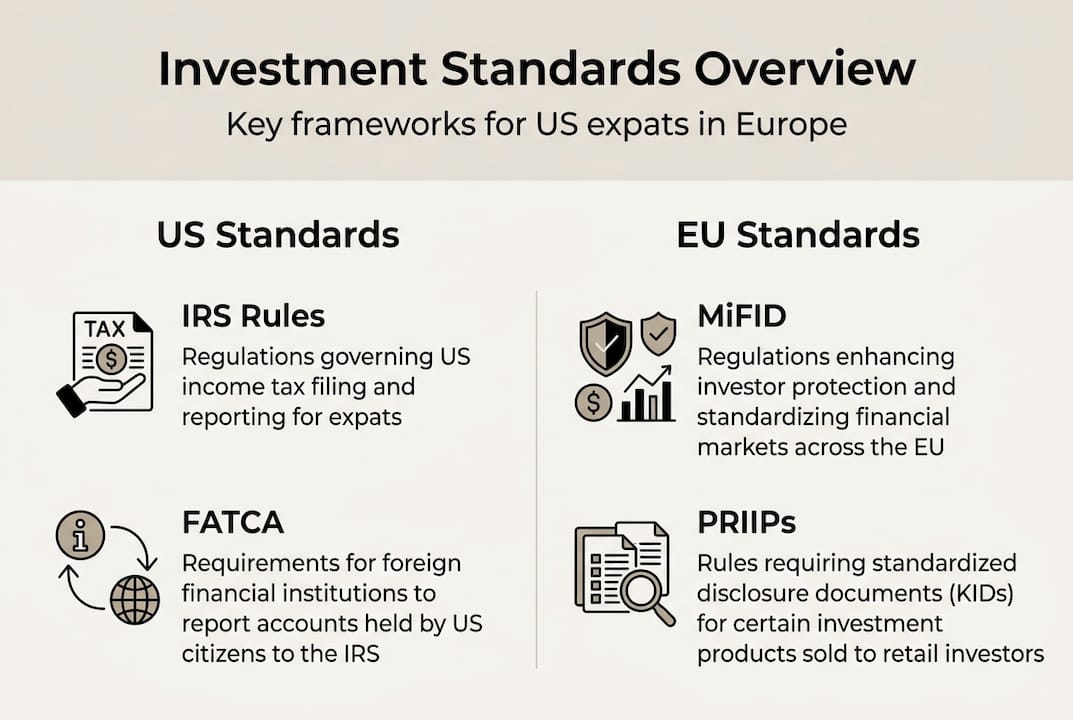
However, GIPS address only performance reporting, not the regulatory framework governing which investments you can access. EU regulations including PRIIPs and MiFID II restrict retail investors in Europe from purchasing many US-domiciled exchange-traded funds. These rules require detailed Key Information Documents that most American fund providers don’t produce for European distribution. Consequently, you’ll often need UCITS alternatives, European funds structured under different regulations with their own tax implications.
This regulatory maze creates practical challenges. You might discover your favourite US ETFs become inaccessible after relocating. Your investment choices narrow significantly. You’ll need to understand how SEC oversight affects US expats alongside European securities regulations. The key standards and regulatory bodies affecting your investment decisions include:
GIPS for performance measurement and ethical reporting standards
SEC regulations governing US-domiciled securities and investment advisers
EU MiFID II investor protection rules and cross-border distribution requirements
PRIIPs regulations mandating Key Information Documents for packaged retail products
ESMA coordination of securities regulation across European Economic Area member states
“GIPS compliance has become the gold standard for institutional investment managers worldwide, providing investors with confidence that performance data is calculated and presented consistently and ethically across different jurisdictions and asset classes.”
Understanding these overlapping frameworks helps you make informed decisions about portfolio construction and adviser selection. The absence of a single universal standard means you must actively coordinate compliance across multiple regulatory regimes rather than relying on one authoritative rulebook.
Navigating cross-border tax planning and compliance for US citizens in Europe
US citizenship creates unique tax obligations that persist regardless of where you live. US citizens are taxed on worldwide income and must report foreign accounts via FBAR and FATCA, distinguishing American expats from citizens of most other nations. This worldwide taxation system means every dividend, capital gain, and interest payment from your European investments faces potential US tax liability, even if you never return to America.
FATCA requires foreign financial institutions to report accounts held by US persons to the IRS. Your European banks and investment platforms must identify you as American and share account details annually. Separately, FBAR mandates that you file FinCEN Form 114 if your combined foreign financial accounts exceed $10,000 at any point during the year. Penalties for non-compliance reach $10,000 per violation for unintentional failures, escalating dramatically for wilful violations.
Tax treaties between the US and European nations provide crucial relief from double taxation. These bilateral agreements typically reduce withholding rates on dividends and interest below statutory rates. For instance, the US-Germany treaty reduces dividend withholding from 26.375% to 15% for portfolio investments. Understanding international tax planning for US expats helps you leverage these treaty benefits effectively.
Annual tax compliance steps for US expats:
File US Form 1040 reporting worldwide income by the extended deadline (typically 15 June for expats)
Submit FinCEN Form 114 (FBAR) by 15 April for foreign accounts exceeding $10,000 aggregate value
Complete Form 8938 (FATCA) if foreign financial assets exceed threshold ($200,000 single, $400,000 married)
File Form 1116 claiming foreign tax credits for taxes paid to European countries
Report foreign pension contributions and distributions on appropriate forms (8891, 8621)
Maintain detailed records of all foreign income, withholding, and account statements
| Country | Standard dividend rate | Treaty rate (portfolio) | Treaty rate (substantial holding) | | — | — | — | | Germany | 26.375% | 15% | 5% (10%+ ownership) | | France | 30% | 15% | 5% (10%+ ownership) | | Netherlands | 15% | 15% | 5% (10%+ ownership) | | Spain | 19% | 15% | 10% (10%+ ownership) | | Ireland | 25% | 15% | 5% (10%+ ownership) |
Pro Tip: File Form 1116 for foreign tax credits even if you use the Foreign Earned Income Exclusion for salary, as investment income doesn’t qualify for the exclusion. This prevents double taxation on dividends and interest by crediting European taxes against your US liability.
The wealth planning benefits for US expats extend beyond simple tax compliance. Strategic planning around timing of asset sales, retirement account distributions, and investment structure can significantly reduce your lifetime tax burden across both jurisdictions.
Avoiding costly tax pitfalls: investment structuring and fund selection
Poor investment choices create unnecessary tax burdens that erode returns over decades. Passive Foreign Investment Companies represent the most significant tax trap for US expats. PFIC investments cause higher taxes and interest charges, while US-domiciled funds help avoid these burdens. The IRS classifies most non-US mutual funds and ETFs as PFICs, subjecting them to punitive taxation designed to eliminate any deferral advantage.

PFIC taxation operates through three possible regimes, all unfavourable. The default excess distribution method taxes gains at your highest ordinary income rate plus interest charges calculated as if you earned income evenly each year you held the investment. The QEF election requires annual reporting of your share of fund income whether distributed or not, creating phantom income tax liability. The mark-to-market election treats unrealized gains as ordinary income annually. None of these outcomes prove attractive compared to standard capital gains treatment.
UCITS funds, the European equivalent of US mutual funds, typically qualify as PFICs despite being the primary investment vehicle available to European retail investors. This creates a painful dilemma: European regulations restrict your access to US funds, but European alternatives trigger PFIC penalties. US-domiciled funds avoid PFIC classification but may be unavailable through your European broker. Understanding regulated investment examples for US expats helps you identify compliant alternatives.
Feature | UCITS funds (PFIC treatment) | US-domiciled funds |
Tax treatment for US persons | Ordinary income rates plus interest charges | Qualified dividend and long-term capital gains rates |
Reporting burden | Complex Form 8621 annually per fund | Standard Form 1099 reporting |
Availability in Europe | Widely available through European brokers | Often restricted under MiFID II rules |
Expense ratios | Generally competitive | Often lower for index funds |
Currency exposure | May offer EUR-hedged versions | Typically USD-denominated |
Criteria for selecting tax-efficient investments as a US expat in Europe:
Prioritise US-domiciled ETFs and mutual funds that avoid PFIC classification
Seek European brokers offering access to US securities for American clients
Consider individual stocks and bonds rather than non-US funds when US funds unavailable
Evaluate Luxembourg or Irish investment platforms catering specifically to US expats
Review fund prospectuses for explicit statements about US person eligibility
Consult specialists about insurance wrappers or other structures that may provide PFIC relief
Pro Tip: Plan your investment structure and tax status before relocation to accelerate gains and reduce exit taxes. Selling appreciated US mutual funds while still US resident allows you to realise gains at favourable long-term capital gains rates before European tax residency complicates your situation.
The wealth management tips for US expats emphasise proactive restructuring rather than reactive problem-solving. Transitioning your portfolio before moving proves far simpler than untangling PFIC complications after several years of European residency.
Choosing reliable financial advisers and aligning with global standards
Finding qualified advice for US-EU cross-border investing challenges even sophisticated investors. No single global investment standards body exists; practitioners focus on aligning with GIPS, MiFID/PRIIPs, and tax treaties. The Santiago Principles govern sovereign wealth funds, but no equivalent framework coordinates private wealth management across borders. You need advisers who understand this fragmented landscape and can navigate multiple regulatory regimes simultaneously.
Most financial advisers specialise in either US or European clients, rarely both. American advisers typically lack expertise in European securities regulations and tax treaties. European advisers often refuse US clients entirely due to FATCA reporting burdens and unfamiliarity with IRS rules. This creates a dangerous gap where you might receive advice that satisfies one jurisdiction’s requirements while violating another’s.
Criteria to select financial advisers specialising in US-EU cross-border investing:
Verify dual registration or licensing in both US (SEC, FINRA, or state) and European jurisdictions
Confirm explicit experience serving US citizens living in Europe, not just generic expat clients
Ask detailed questions about their approach to PFIC avoidance and tax treaty optimisation
Request references from other American expat clients in similar financial situations
Ensure they coordinate with qualified US tax professionals (CPAs or enrolled agents)
Check their familiarity with both US-domiciled and UCITS investment products
Evaluate their fee structure for transparency and alignment with your interests
Advisers knowledgeable about IRS rules, EU compliance including MiFID and PRIIPs, and tax treaty benefits prove invaluable. They help you structure investments to minimise tax leakage whilst maintaining compliance across jurisdictions. They understand which US brokers accept European residents and which European platforms accommodate American clients. This specialised knowledge prevents costly mistakes that generalist advisers might overlook.
The complexity of cross-border wealth management often requires a coordinated team rather than a single adviser. Your ideal setup might include a US-based CPA specialising in expat taxation, a European-licensed financial adviser familiar with American clients, and potentially a cross-border tax attorney for complex situations involving business ownership or substantial assets. Smart financial planning for expats recognises that comprehensive advice comes from coordinated specialists rather than generalists.
Pro Tip: Engage coordinated teams of CPAs, tax lawyers, and financial advisers for complex cross-border portfolios. Annual coordination meetings where your entire advisory team discusses your situation together prevent conflicting advice and ensure everyone understands how their recommendations interact with other aspects of your financial life.
Vetting specialists requires diligence similar to vetting mortgage specialists for expats. Ask specific technical questions about PFIC treatment, treaty benefits, and reporting requirements. Qualified advisers answer confidently with practical examples. Those who deflect or provide vague responses likely lack the specialised expertise you need.
How Link Independent helps US expats manage investments abroad
Navigating the complexities of global investment standards and cross-border tax compliance demands specialised expertise that few advisers possess. Link Independent connects US expats in Europe with verified, regulated financial professionals who understand both American and European regulatory frameworks. Our platform eliminates the frustration of finding advisers who actually serve US citizens abroad, matching you with specialists experienced in PFIC avoidance, tax treaty optimisation, and compliant investment structuring.
[

We provide personalised guidance on tax compliance strategies, investment restructuring before and after relocation, and vetting qualified advisers across multiple jurisdictions. Our smart financial planning resources offer detailed insights into managing your wealth efficiently whilst maintaining full compliance with IRS and European regulations. Whether you’re planning your move or already established in Europe, Link Independent helps you secure and optimise your financial future abroad.
Frequently asked questions
What does compliance with GIPS mean for investors?
GIPS compliance means an investment manager calculates and presents performance data according to standardised ethical principles, allowing you to compare track records fairly across different firms and countries. It doesn’t guarantee returns but ensures transparency and consistency in how results are reported.
How do US FATCA and FBAR rules affect expat investments?
FATCA requires your foreign financial institutions to report your accounts to the IRS, whilst FBAR mandates you directly report foreign accounts exceeding $10,000 aggregate value annually. Non-compliance triggers substantial penalties, making accurate record-keeping essential for all foreign investments and bank accounts.
What investment types help US expats avoid PFIC penalties?
US-domiciled mutual funds and ETFs avoid PFIC classification, as do individual stocks and bonds purchased directly. Prioritise these over non-US funds when possible, or consult specialists about structures that may provide relief from PFIC treatment whilst maintaining European regulatory compliance.
How do US-EU tax treaties help reduce double taxation?
Tax treaties between the US and European nations reduce withholding rates on dividends and interest below statutory levels, typically to 15% or lower. You claim foreign tax credits on Form 1116 to offset US tax liability with European taxes already paid, preventing the same income from being fully taxed twice. Understanding international tax planning for US expats helps you maximise these treaty benefits.
Why is pre-relocation financial planning essential?
Restructuring investments before establishing European tax residency allows you to realise capital gains at US rates and transition away from investments that become problematic under PFIC rules. Planning ahead prevents being locked into tax-inefficient structures that prove difficult and expensive to unwind after relocation.
Recommended
Comments