

How to Vet Mortgage Specialists for US Expats in Europe
- Jan 27
- 11 min read

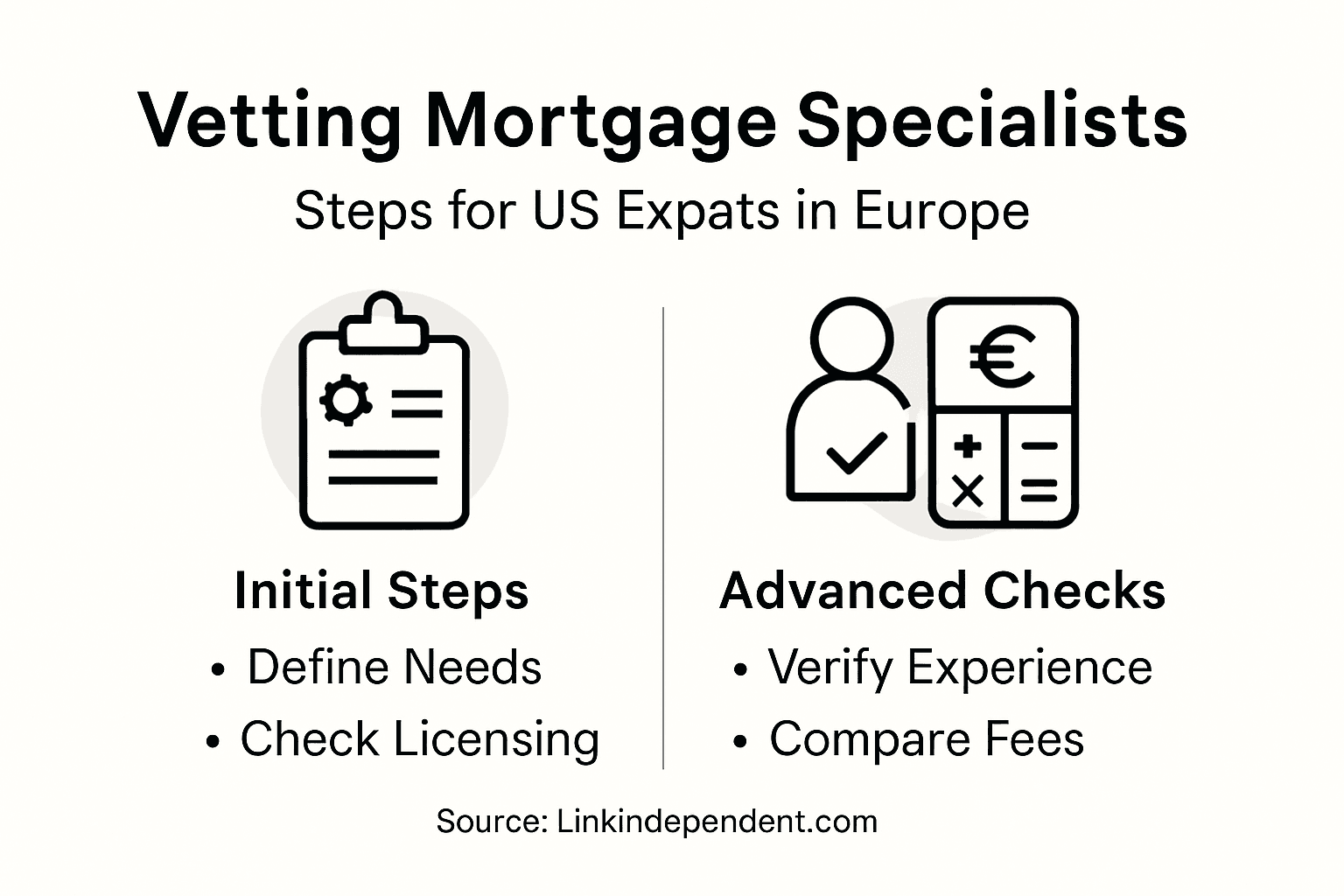
Finding a trustworthy mortgage specialist can feel overwhelming when you’re an American considering a move to France or Spain. Picking the right adviser is about far more than just language skills or impressive websites. You need someone with proven experience in cross-border finance who holds relevant licences and offers clear guidance on complex requirements, regional laws, and currency risks. This guide shows you how to vet specialists confidently so you avoid costly mistakes and secure advice that truly fits your needs.
Table of Contents
Quick Summary
Key Point | Explanation |
1. Define your mortgage requirements | Identify the target country, property type, and assess your financial situation before consulting specialists. |
2. Research regulated specialists | Ensure the mortgage specialist is properly licensed and complies with local regulations to protect yourself legally. |
3. Verify credentials and experience | Check the specialist’s qualifications in the buying country and their experience with American expat cases specifically. |
4. Understand fee structures | Request detailed fee breakdowns upfront to avoid hidden charges and clarify how they are compensated. |
5. Confirm ongoing support | Choose a specialist who offers continued assistance throughout your relocation process and beyond for better guidance. |
Step 1: Define your cross-border mortgage requirements
Before you start approaching mortgage specialists, you need a clear picture of what you’re actually looking for. This isn’t about picking a random property in Spain or France and hoping the numbers work out. You’re defining the financial blueprint that will guide every conversation with potential lenders and advisers.
Start by identifying which country you’re targeting and what type of property you want. Are you buying a residential apartment in Paris, a villa on the Spanish coast, or something else entirely? The location matters because international mortgages have different eligibility criteria based on property type, lender rules, and local regulations. Your dream home in one country might face entirely different lending requirements than the same property type elsewhere.
Next, assess your financial position honestly. How much can you actually afford to put down, and how much do you need to borrow? Currency risk is real when you’re an American earning dollars but repaying a mortgage in euros. Consider whether you’ll be converting money regularly or if your income already comes from Europe. Understanding your loan-to-value ratio requirements and documentation needs helps you avoid surprises later. Most lenders will ask for proof of income, employment history, and existing debts.
Think about your residency status and how long you plan to stay. Are you a temporary expat or settling permanently? Some lenders favour established residents over those on short-term visas. Your residency classification directly affects which products you qualify for and what interest rates you’ll receive. This is also the moment to consider how your US tax obligations and assets factor into your borrowing capacity.
Finally, clarify your timeline and whether you need the mortgage in place quickly or have months to prepare. When you connect with cross-border financial experts, having these details prepared means conversations move faster and recommendations feel more tailored.
Pro tip Write down your target country, property type, estimated budget, current visa status, and timeline before your first conversation with a mortgage specialist. This single document transforms vague ideas into actionable mortgage requirements.
Step 2: Research regulated and licensed specialists
Not all mortgage specialists are created equal. The difference between working with a properly regulated adviser and an unregulated one could cost you thousands of pounds or leave you with inadequate legal protection. This step ensures you’re only considering professionals who meet strict compliance standards.

Start by verifying that any specialist you’re considering operates under proper regulatory oversight. In the European Union, mortgage providers and advisers must comply with national licensing and consumer protection rules to operate legally. Ask prospective advisers which financial regulator oversees their business. Are they registered with France’s Autorité de Contrôle Prudentiel, Spain’s Banco de España, or another official body? Their answer tells you immediately whether they’re legitimate.
Look for specialists who work as cross-border mortgage brokers with access to multiple lenders rather than just one institution. These professionals typically have deeper knowledge of international regulations and can connect you with options tailored to your situation. Check whether they hold proper professional indemnity insurance and ask how long they’ve been operating in the cross-border space. Experience matters when navigating different countries’ lending standards and documentation requirements.
Read client reviews and testimonials from other American expats if possible. Look for mentions of transparency, responsiveness, and successful outcomes. Pay attention to complaints about hidden fees or unclear processes. You want someone who explains things clearly and doesn’t make promises that sound too good to be true. Trust your instincts if something feels off during initial conversations.
Request references from recent clients and actually contact them. Ask about their experience with the adviser’s regulatory compliance, how well they explained cross-border mortgage options, and whether the process moved smoothly. These conversations take time but save you from costly mistakes.
Pro tip Create a simple checklist confirming each specialist’s regulatory status, professional insurance, client references, and years of cross-border experience before scheduling your first consultation.
Step 3: Verify credentials and local compliance
Credentials matter more than you might think. A specialist with impressive qualifications in the United States might not be licensed to give mortgage advice in France or Spain. Verification protects you from working with someone operating outside legal boundaries.
Start by checking whether the specialist holds valid credentials in the specific country where you’re buying property. Ask directly which regulatory body oversees their operations and request proof of registration. In France, this might be the Autorité de Contrôle Prudentiel et de Résolution. In Spain, it could be the Banco de España or Comisión Nacional del Mercado de Valores. Each country maintains public registries where you can independently verify licensing status online. Don’t rely on their word alone.
Here is a quick reference comparing regulatory bodies for mortgage specialists in popular European countries:
Country | Main Regulator | Public Registry Online |
France | Autorité de Contrôle Prudentiel et de Résolution | Yes, searchable by consumers |
Spain | Banco de España, Comisión Nacional del Mercado de Valores | Yes, official websites verify status |
Italy | Banca d’Italia | Yes, online public directory |
Portugal | Banco de Portugal | Yes, accessible electronic register |
Confirm that mortgage providers comply with national and European Union regulations including creditworthiness assessments and transparent disclosure requirements. Legitimate specialists can explain how they assess your borrowing capacity and should provide written documentation of all terms before you commit. If they’re vague about regulatory requirements or reluctant to discuss compliance, that’s a red flag.
Ask about their experience operating in cross-border situations specifically. Have they helped other American expats purchase property in the country you’re targeting? Can they explain how US tax residency affects mortgage qualification? A specialist with genuine cross-border experience will speak knowledently about FATCA reporting, currency hedging options, and how your US citizenship impacts lending decisions.
Verify that they maintain professional indemnity insurance covering mistakes or negligence. This insurance protects you financially if something goes wrong. Request their insurance details and confirm coverage limits are appropriate for international transactions.
Pro tip Request written confirmation of the specialist’s regulatory registration and insurance details, then verify this information independently through the relevant country’s financial regulator before proceeding further.
Step 4: Assess experience with US expat cases
Not every mortgage specialist understands American expatriates. Your situation is uniquely complex because you’re navigating two countries’ financial systems simultaneously. A generalist might miss critical issues that could derail your application or cost you money.
Look for specialists with documented experience helping American expats specifically. Ask how many US citizens they’ve assisted with mortgage applications in the past two years. Request case studies or examples showing how they’ve handled situations similar to yours. Someone genuinely experienced will speak fluently about the specific challenges you face, without needing you to explain basic concepts.
Understanding cross-border mortgage complexities is essential because US expats face unique obstacles. You need someone who grasps how currency risks affect your repayment capacity, how FATCA reporting impacts lender decisions, and why your US tax residency matters to European lenders. They should explain how they verify your income when you’re earning in dollars but applying for a euro-denominated mortgage. This knowledge separates experienced cross-border specialists from ordinary mortgage brokers.
Ask directly about their experience with credit verification challenges. Lenders in some European countries struggle to assess US credit histories properly. An experienced specialist knows which lenders accept US credit reports, how to explain gaps in your European credit file, and what documentation strengthens weak credit profiles. They’ve navigated these problems before and can anticipate potential issues.
Inquire whether they maintain relationships with lenders actively interested in US expat cases. Some banks have dedicated expat lending programmes whilst others avoid American borrowers entirely. A specialist with established connections can access better terms and approvals that you wouldn’t find independently. Ask them to name specific lenders they work with regularly for expat mortgages.
Pro tip Ask the specialist to explain how your US citizenship affects their lending process without you prompting them. Their answer reveals whether they truly specialise in expat cases or are simply hoping to wing it.
Step 5: Review fee structures and transparency
Hidden fees destroy trust and drain your budget. Before committing to any mortgage specialist, you need complete clarity on what they’re charging and how they profit from your transaction. Vague fee structures are a warning sign.
Request a detailed written breakdown of all fees upfront. Ask the specialist to itemise every cost separately: their broker commission, application fees, valuation fees, legal fees, and any administrative charges. Each item should have a specific amount or percentage clearly stated. If they provide a rough estimate or refuse to give details, move on. You deserve transparent pricing before you’re locked into an agreement.
Ensure the specialist complies with clear disclosure of all mortgage-related costs as required by European Union regulations. This includes interest rates, commissions, admin fees, and early repayment penalties. Ask them to provide a formal standardised cost disclosure document showing everything you’ll pay over the loan’s lifetime. Legitimate specialists offer this willingly because they’ve nothing to hide.
Understand how the specialist gets paid. Are they earning commission from the lender, a fee from you, or both? Commission-only advisers may push you towards expensive products that benefit them more than you. Fee-only specialists charge you directly but typically provide more objective advice. Ask explicitly whether they receive bonuses or incentives for directing clients to particular lenders.
Compare fee structures across multiple specialists. You might discover one charges 0.5 per cent whilst another charges 2 per cent for identical services. These differences compound significantly on larger mortgages. Request quotes in the same format from each specialist so you can compare fairly.
Ask about early repayment penalties and whether fees apply if you exit the arrangement. Some specialists charge cancellation fees if you don’t proceed with their recommended lender. Understand these costs before you’re committed.
Pro tip Request fee quotes in writing from at least three specialists, formatted identically, then calculate the total cost difference across your mortgage term before deciding.
Step 6: Confirm ongoing support for your relocation
Your relationship with a mortgage specialist shouldn’t end when you sign the paperwork. Relocating to Europe involves ongoing challenges that extend far beyond mortgage approval. A quality specialist provides continued support throughout your transition and beyond.
Ask prospective specialists what happens after mortgage completion. Will they remain available to answer questions about your loan, help with refinancing options, or clarify documents from your lender? Some specialists disappear once the commission clears. Others maintain ongoing client relationships and provide valuable guidance as your circumstances change. Choose someone committed to the latter approach.
Confirm they can help with post-completion matters specific to your situation. Currency fluctuations might make refinancing worthwhile in the future. Your income situation may shift, affecting your ability to service the debt. Tax implications could evolve as you establish residency. A specialist experienced with cross-border mortgages understands these long-term considerations and plans for them proactively.
Ask whether they provide guidance on integrating your mortgage into broader financial planning. Your European property purchase is one piece of a larger financial picture. Where does it fit alongside your US retirement accounts, investment strategy, and tax obligations? Ideally, your mortgage specialist can either provide this perspective or connect you with other professionals who can, ensuring your decisions align cohesively.
Inquire about their communication channels and response times. Will they respond to emails within 48 hours? Can you call them directly or must you go through an intermediary? During stressful moments in your relocation, quick access to someone who understands your situation matters tremendously.
Check whether they offer support in multiple languages if English isn’t your first language. Clear communication becomes even more critical when discussing complex financial matters involving two countries’ regulations.
To assist you in evaluating mortgage specialists, here is a summary of important comparison factors:
Factor | Why It Matters | How to Verify |
Regulatory Status | Ensures legal compliance and protection | Request registration details |
Indemnity Insurance | Safeguards against professional negligence | Review current insurance documents |
Cross-border Experience | Indicates familiarity with expat-specific issues | Ask for relevant case studies |
Transparent Fee Structure | Avoids hidden and excessive costs | Obtain detailed fee breakdowns |
Post-completion Support | Provides ongoing assistance during relocation | Confirm ongoing services in writing |
Pro tip During your initial consultation, ask the specialist to walk you through what post-completion support looks like and request written confirmation of their availability and response protocols before committing.
Secure Expert Guidance for Your Cross-Border Mortgage Journey
Navigating the complex world of mortgages as a US expat in Europe demands trusted, regulated professionals who understand your unique challenges. From verifying credentials and understanding residency restrictions to managing currency risks and transparent fees, every step calls for expert insight. Avoid costly mistakes and hidden fees by connecting with verified advisers specialising in international mortgages and US expat scenarios.

Discover how Linkindependent.com simplifies your search by matching you with licensed mortgage specialists and financial experts who comply with local laws and global regulations. Take control of your relocation with personalised support covering cross-border taxation, asset investments and pension planning. Start your journey today with free consultations from trusted advisers who put your interests first. Visit Linkindependent.com now and experience a transparent, independent approach to international mortgage solutions.
Frequently Asked Questions
How can I ensure a mortgage specialist is properly regulated?
A regulated mortgage specialist will operate under the oversight of a relevant financial authority. Verify their regulatory registration by asking which body oversees their operations and checking their credentials through publicly available records.
What should I ask a mortgage specialist about their experience with US expats?
Inquire specifically about their experience assisting American citizens in securing mortgages. Request to see case studies or examples of previous American expat clients they have worked with, as this will indicate their familiarity with your unique situation.
How do I determine the fees associated with a mortgage specialist?
Request a detailed, written breakdown of all fees upfront, including broker commissions, application fees, and legal charges. Ensure they provide clear pricing to avoid any hidden fees that could lead to unexpected costs.
Why is ongoing support important after securing a mortgage?
Ongoing support ensures you have access to assistance as your financial situation changes or if you encounter issues related to your mortgage. Confirm that the specialist will remain available for questions regarding your loan or potential refinancing options after completion.
What documents should I prepare before consulting a mortgage specialist?
Prepare essential documents such as proof of income, employment history, and existing debts, along with your residency status and target property details. Having these documents ready can streamline your consultations and provide the specialist with a clearer understanding of your needs.
Recommended
Comments