

Holistic Financial Planning: Making Cross-Border Finances Work
- Jan 18
- 8 min read

Managing finances as an American moving to Europe often brings unexpected complexity, where tax rules, investment options, and retirement accounts like 401k must align across borders. This challenge matters because every missed detail can impact your financial security and quality of life abroad. By starting with a holistic financial planning approach that connects tax, investment, and retirement strategies, you gain clarity and control to thrive no matter where life takes you.
Table of Contents
Key Takeaways
Point | Details |
Holistic Approach | Holistic financial planning integrates various aspects of personal finance into a cohesive strategy, acknowledging their interconnections. |
Tailored Strategies for Expats | American expats require customised financial plans that address cross-border taxation and local compliance needs. |
Proactive Monitoring | Continuous assessment and adjustments of financial plans are essential to adapt to evolving regulations and personal circumstances. |
Professional Guidance | Seeking advisers with cross-border expertise ensures robust strategies that minimise risks and align with long-term goals. |
Defining Holistic Financial Planning Principles
Holistic financial planning represents a comprehensive approach to managing wealth that transcends traditional transactional methodologies. Rather than viewing financial elements in isolation, this strategy considers an individual’s entire economic ecosystem, integrating multiple aspects of personal finance into a cohesive, strategic framework. The evidence-based financial planning principles developed by financial experts emphasise understanding an individual’s complete financial landscape.
At its core, holistic financial planning recognises that personal finance is deeply interconnected. Investments, retirement strategies, tax planning, risk management, and estate considerations are not standalone components but intricate parts of a larger financial narrative. American expats relocating to Europe, for instance, require nuanced approaches that account for cross-border taxation, international investment regulations, pension transferability, and diverse economic environments. This means developing strategies that are flexible, adaptive, and personalised to unique individual circumstances.
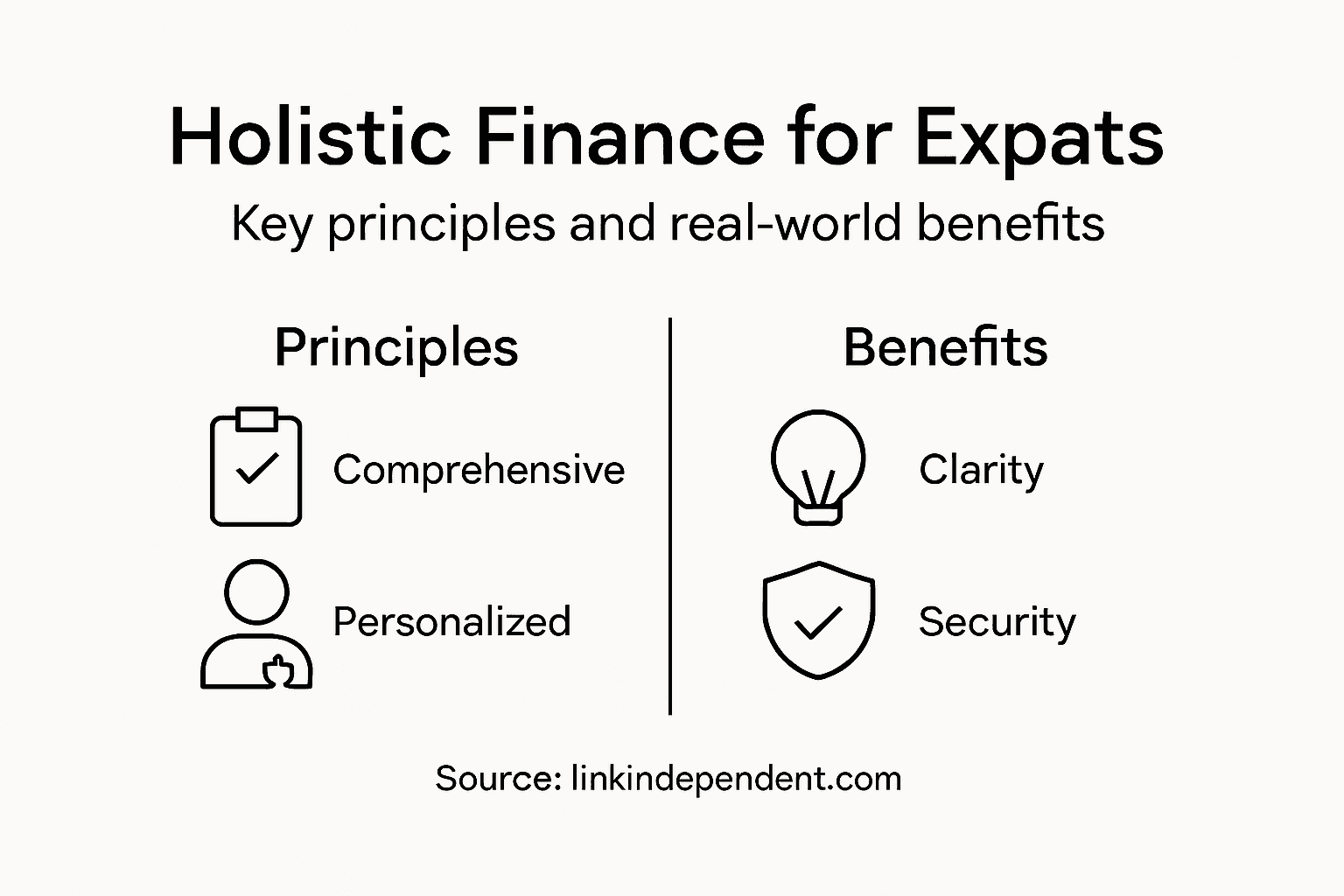
The fundamental principles of holistic financial planning include comprehensive assessment, personalised strategy development, continuous monitoring, and proactive adjustment. Successful implementation involves gathering detailed financial information, understanding personal goals, identifying potential risks, and creating a dynamic roadmap that evolves with changing life circumstances. Professionals specialising in this approach utilise sophisticated analytical tools to provide tailored recommendations that align financial actions with long-term objectives.
Below is a summary of how holistic financial planning principles align with the unique needs of American expats relocating to Europe:
Principle | Application for Expats | Resulting Benefit |
Comprehensive Assessment | Evaluates global assets and liabilities | Prevents oversight across borders |
Personalised Strategy | Tailors financial plans to jurisdiction | Ensures local compliance |
Continuous Monitoring | Adapts to evolving regulations | Maintains long-term stability |
Proactive Adjustment | Responds to tax and legal changes | Minimises relocation pitfalls |
Pro Tip: When beginning your holistic financial planning journey, start by creating a comprehensive inventory of all your financial assets, liabilities, income streams, and long-term goals to provide a clear foundation for strategic decision-making.
Types Of Holistic Financial Advice Available
The landscape of financial advice has transformed dramatically, moving beyond traditional investment recommendations to more comprehensive service models. Evolving advisory approaches now encompass multiple dimensions of an individual’s financial ecosystem, addressing complex needs with sophisticated, integrated strategies. This shift reflects a growing understanding that financial well-being requires a holistic perspective that connects seemingly disparate financial elements.
Comprehensive financial advice typically includes several interconnected service categories. These range from investment management and retirement planning to tax strategy, insurance evaluation, and estate planning. For American expats relocating to Europe, this means finding advisers who understand cross-border complexities, can navigate international tax regulations, and provide personalised strategies that account for diverse economic environments. Some key types of holistic financial advice include:
Investment Management: Developing diversified investment portfolios aligned with individual risk tolerance and long-term goals
Retirement Planning: Creating sustainable income strategies across different jurisdictions
Tax Planning: Minimising tax liabilities through strategic financial structuring
Risk Management: Evaluating and mitigating potential financial vulnerabilities
Estate Planning: Ensuring efficient wealth transfer and legacy protection
The most effective holistic financial advice transcends transactional interactions, offering dynamic, personalised guidance that adapts to changing life circumstances. Professionals in this field utilise advanced analytical tools and deep understanding of global financial landscapes to provide nuanced recommendations that integrate multiple financial disciplines.
Pro Tip: When seeking holistic financial advice, prioritise advisers with demonstrated experience in cross-border financial management and a proven track record of creating comprehensive, personalised financial strategies.
How Holistic Planning Supports Expats Abroad
Holistic financial planning provides a comprehensive framework for American expats navigating the complex challenges of international relocation. Successful expatriate adjustment requires a multifaceted approach that goes beyond traditional financial management, addressing the intricate personal and professional dimensions of living abroad. This strategy recognises that financial well-being is deeply interconnected with broader life experiences, cultural adaptation, and long-term personal goals.
For expats, holistic planning encompasses several critical support dimensions. These include pre-assignment financial preparation, ongoing economic strategy management, tax optimisation across jurisdictions, investment portfolio restructuring, and comprehensive risk assessment. The approach considers not just individual financial metrics, but also family dynamics, career progression, healthcare requirements, and potential repatriation scenarios. Key support areas typically involve:
Income Stabilisation: Developing strategies to maintain consistent earning potential across different economic environments
Tax Efficiency: Navigating complex international tax regulations to minimise liabilities
Investment Diversification: Creating globally balanced portfolios that adapt to changing economic landscapes
Retirement Planning: Ensuring continuous pension and savings growth despite geographical transitions
Risk Management: Providing insurance and financial protection strategies tailored to international living
The most effective holistic planning recognises that expatriate success depends on integrated support that addresses financial, personal, and professional needs simultaneously. Professionals specialising in expat financial services utilise sophisticated analytical tools and deep understanding of global economic nuances to create personalised, adaptive strategies that evolve with changing life circumstances.

Pro Tip: Commence your international relocation planning at least 12 months in advance, allowing sufficient time to develop a comprehensive financial strategy that addresses potential cross-border complexities.
Key Responsibilities Of Planners And Clients
Successful cross-border financial planning demands a collaborative partnership with clear, well-defined responsibilities for both financial planners and their clients. Financial planning process fundamentals emphasise mutual accountability and transparent communication as critical elements in achieving comprehensive financial objectives. This collaborative approach ensures that strategies are not only technically sound but also personally aligned with individual client needs and aspirations.
The responsibilities of financial planners typically encompass a comprehensive range of professional obligations:
Ethical Conduct: Maintaining highest standards of professional integrity
Comprehensive Analysis: Gathering and thoroughly evaluating client financial information
Conflict Disclosure: Transparently communicating any potential conflicts of interest
Strategic Recommendation: Developing personalised financial strategies
Ongoing Monitoring: Regularly reviewing and adjusting financial plans
Correspondingly, clients bear significant responsibilities in ensuring the effectiveness of their financial planning journey. These include providing accurate and complete financial information, clearly articulating personal and financial goals, maintaining open communication, and actively participating in decision-making processes. The relationship requires mutual trust, where clients must be transparent about their financial situation, risk tolerance, and long-term objectives, while planners must demonstrate expertise, integrity, and a commitment to achieving client-centric outcomes.
Pro Tip: Prepare a comprehensive financial document portfolio before your first consultation, including income statements, asset details, existing investment records, and a clear outline of your financial goals to maximise the initial planning session.
Navigating Cross-Border Taxation And Compliance
Cross-border taxation represents one of the most complex financial challenges for American expats relocating to Europe. International tax coordination efforts have become increasingly sophisticated, addressing the intricate challenges posed by global economic mobility and digital transformation. These frameworks aim to create transparent, fair taxation systems that prevent double taxation while ensuring appropriate revenue collection across multiple jurisdictions.
For American expats, navigating cross-border taxation requires understanding several critical dimensions:
Residency Status: Determining tax obligations in both home and host countries
Income Classification: Understanding how different income types are taxed internationally
Tax Treaty Implications: Leveraging bilateral agreements to minimise tax liabilities
Reporting Requirements: Complying with reporting standards like FATCA and FBAR
Asset Declaration: Correctly reporting international investments and financial holdings
Successful compliance demands proactive strategies and detailed knowledge of international tax regulations. American expatriates must work closely with cross-border tax specialists who understand the nuanced interactions between United States and European tax systems. This involves comprehensive documentation, strategic financial planning, and a thorough understanding of each jurisdiction’s specific tax laws, reporting deadlines, and potential penalties for non-compliance.
Pro Tip: Maintain meticulous financial records and consult a cross-border tax specialist at least six months before international relocation to develop a comprehensive tax compliance strategy.
Avoiding Common Pitfalls In Expatriate Finances
American expats face numerous financial challenges that can potentially derail their international relocation experience. Expatriate financial failure patterns reveal that successful transitions demand more than just financial acumen, requiring comprehensive preparation and holistic strategic planning. Understanding these potential pitfalls is crucial for maintaining financial stability and personal well-being during international relocations.
The most critical financial pitfalls for expatriates typically include:
Inadequate Tax Planning: Failing to understand complex cross-border taxation requirements
Currency Exchange Risks: Not hedging against currency fluctuations
Retirement Fund Complications: Mismanaging pension transfers and international retirement accounts
Insurance Coverage Gaps: Overlooking differences in healthcare and personal insurance systems
Investment Strategy Misalignment: Creating portfolios incompatible with new residency regulations
Navigating these challenges requires proactive research, professional guidance, and a willingness to adapt financial strategies to new economic environments. American expats must develop a nuanced understanding of both United States and European financial regulations, seeking specialised advice that can provide targeted insights into managing wealth across different jurisdictional frameworks. This involves comprehensive documentation, strategic financial planning, and continuous education about evolving international financial landscapes.
The table below compares expat financial challenges with corresponding professional solutions for maintaining stability abroad:
Challenge | Professional Solution |
Double taxation risk | International tax treaty expertise |
Currency fluctuation uncertainty | Currency hedging and forecasting |
Retirement plan incompatibility | Pension transfer and restructuring |
Insufficient insurance cover | Global health and asset protection |
Investment regulatory mismatch | Cross-border compliant portfolio design |
Pro Tip: Create a detailed financial transition checklist at least nine months before relocation, documenting all potential cross-border financial considerations and scheduling consultations with international financial specialists.
Take Control of Your Cross-Border Finances with Expert Guidance
Managing holistic financial planning across borders brings complex challenges such as tax compliance, personalised investment strategies, and adapting to evolving regulations. This article highlights how American expats face risks like double taxation, pension transfer complications, and currency fluctuations when relocating to Europe. The need for detailed financial assessment, continuous monitoring, and proactive adjustment is clear for safeguarding your financial future abroad.
Do not let these complexities overwhelm you. With trusted advice tailored to your unique circumstances, you can confidently navigate international wealth management and cross-border taxation. At Linkindependent.com, we connect you with verified, regulated financial experts who specialise in cross-border matters including taxes, pensions, retirement planning, and investment diversification. Find the right adviser who truly understands the challenges you face as an expat or international investor.

Discover personalised strategies that work for your global financial situation now. Visit Linkindependent.com to start your journey in three simple steps: define your needs, meet verified professionals, and schedule your free consultation. Don’t delay gaining clarity and stability across your cross-border finances.
Frequently Asked Questions
What is holistic financial planning?
Holistic financial planning is a comprehensive approach to managing wealth that integrates all aspects of personal finance, such as investments, retirement strategies, tax planning, and estate considerations, into a cohesive strategy that adapts to individual circumstances.
How does holistic financial planning benefit expatriates?
Holistic financial planning helps expatriates manage cross-border complexities, ensuring that their financial strategies are compliant with local regulations and tailored to their unique financial landscape, ultimately providing stability and growth during their relocation journey.
What types of services are included in holistic financial advice?
Holistic financial advice typically includes investment management, retirement planning, tax strategy, risk management, and estate planning, all tailored to meet the interconnected needs of an individual’s financial ecosystem.
How can expats navigate cross-border taxation effectively?
Expats can navigate cross-border taxation by understanding their residency status, income classification, and leveraging tax treaties to minimise liabilities. Working closely with cross-border tax specialists is essential to comply with reporting requirements and optimise tax compliance.
Recommended


Comments