

US expat tax implications in Europe: £120K FEIE benefit
- a few seconds ago
- 10 min read

Moving to Europe doesn’t free you from US tax obligations. Many American expats believe paying foreign taxes exempts them from filing US returns, but the IRS requires worldwide income reporting regardless of where you live or pay taxes. Understanding your obligations under FEIE, FBAR, FATCA and tax treaties helps you stay compliant whilst optimising your tax position across borders.
Table of Contents
Key takeaways
Point | Details |
Worldwide filing obligation | US citizens must file annual tax returns reporting all global income, even if foreign taxes are paid. |
Foreign Earned Income Exclusion | FEIE excludes up to £120,000 of foreign earnings for qualifying expats in 2026. |
Foreign account reporting | FBAR requires disclosure of foreign accounts exceeding $10,000 aggregate balance annually. |
Tax treaty benefits | US-European treaties reduce double taxation but require proper claiming and don’t eliminate all taxes. |
Professional guidance essential | Licensed cross-border advisers ensure compliance and optimise tax treatment of income, pensions and investments. |
Understanding US tax filing obligations for expats
US citizenship creates a lifelong tax filing obligation regardless of residence. Whether you live in Berlin, Paris or Barcelona, the IRS expects you to file Form 1040 annually reporting your worldwide income. This requirement exists separately from any foreign tax payments you make to your European host country.
The Foreign Earned Income Exclusion provides relief for many expats, but filing remains mandatory. Standard income thresholds apply, yet most expats exceed them due to combined global earnings. Schedule B disclosure of foreign financial interests adds another layer of reporting complexity.
Pro Tip: Track your physical presence carefully. Missing the filing threshold doesn’t exempt you from FBAR or FATCA reporting obligations, which operate independently of income tax requirements.
Failure to file carries penalties even when no tax is owed. The IRS doesn’t waive filing obligations simply because you paid foreign taxes or earned income abroad. Your key filing obligations include:
Annual Form 1040 reporting worldwide income from all sources
Schedule B when foreign account interest or dividends exceed thresholds
Additional forms for foreign corporations, partnerships or trusts
State tax returns if you maintain US state residency ties
Many expats mistakenly believe their wealth management strategies exempt them from US reporting. Understanding these foundational obligations prevents costly surprises and positions you for proper tax planning.
Foreign Earned Income Exclusion and Foreign Tax Credit
The FEIE allows qualifying expats to exclude up to £120,000 of foreign employment income from US taxation in 2026. This powerful benefit requires meeting either the bona fide residence test or physical presence test, demonstrating genuine ties to your European host country.

The bona fide residence test examines your intent to remain abroad indefinitely. Physical presence requires spending 330 full days outside the US during any 12 month period. Both tests demand careful documentation and planning, particularly for those who travel frequently for work or family visits.
Pro Tip: FEIE covers only earned income from employment or self-employment. Passive income like dividends, interest, rental income and capital gains receives no exclusion and may face full US taxation.
FEIE and FTC comparison for 2026
Benefit | FEIE | Foreign Tax Credit |
Maximum benefit | £120,000 exclusion | Dollar for dollar credit |
Income types | Earned income only | All income types |
Qualifying test | Residence or presence | Foreign tax paid |
Form required | Form 2555 | Form 1116 |
Carryover | No | Yes, 10 years |
The Foreign Tax Credit (FTC) offers an alternative or complementary approach. FTC provides dollar for dollar credit against US tax for foreign income taxes you actually paid. This proves particularly valuable for high earners exceeding FEIE limits or those with substantial passive income.
Combining FEIE and FTC often yields optimal results. Use FEIE to exclude earned income up to the threshold, then apply FTC against any remaining US tax liability on income above the exclusion or passive income. This layered approach through proper international tax planning maximises your tax savings whilst maintaining full compliance.
Follow these steps to claim benefits correctly:
Determine which test (residence or presence) you qualify under
Calculate your foreign earned income and housing costs
Complete Form 2555 for FEIE and Form 1116 for FTC
Maintain detailed records of days abroad and foreign taxes paid
File timely to preserve your eligibility for future years
FBAR and FATCA reporting requirements
FBAR filing represents a separate obligation from your tax return. FinCEN Form 114 must be submitted electronically by 15 April each year, with an automatic extension to 15 October. This reporting requirement captures foreign accounts exceeding $10,000 in aggregate balance at any point during the calendar year.
The $10,000 threshold applies to your combined maximum balances across all foreign accounts. If your German current account peaked at $6,000 whilst your French savings account reached $5,000 on different dates, you exceeded the threshold and must file. Joint accounts, signature authority and financial interest all trigger reporting obligations.
Pro Tip: FBAR filing is free and straightforward through the BSA E-Filing System. Missing the deadline can trigger penalties of $10,000 per violation for non-wilful failures, escalating dramatically for wilful violations.
FATCA creates parallel reporting through Form 8938, filed with your tax return. Foreign asset thresholds vary by filing status, ranging from $50,000 to $600,000 depending whether you’re single, married or qualify as a bona fide resident abroad. These thresholds apply to total asset values on the last day of the tax year or any point during the year.
Key differences between FBAR and FATCA include:
FBAR counts only financial accounts whilst FATCA captures broader foreign assets
FBAR uses maximum balances whilst FATCA uses year end values plus maximum values
FBAR goes to FinCEN whilst FATCA goes to IRS with your return
Penalties differ significantly between the two reporting regimes
Both require disclosure even if accounts generated no taxable income
Working with cross-border advisers ensures you identify all reportable accounts and file correctly. European investment accounts, pension schemes, life insurance policies and business interests may trigger reporting obligations you hadn’t considered.
Double taxation and tax treaty basics
Double taxation occurs when both the US and your European host country tax the same income. You earn wages in Germany, pay German income tax, then face US tax on those same wages. Without relief mechanisms, your effective tax rate could exceed 50 per cent on foreign earnings.
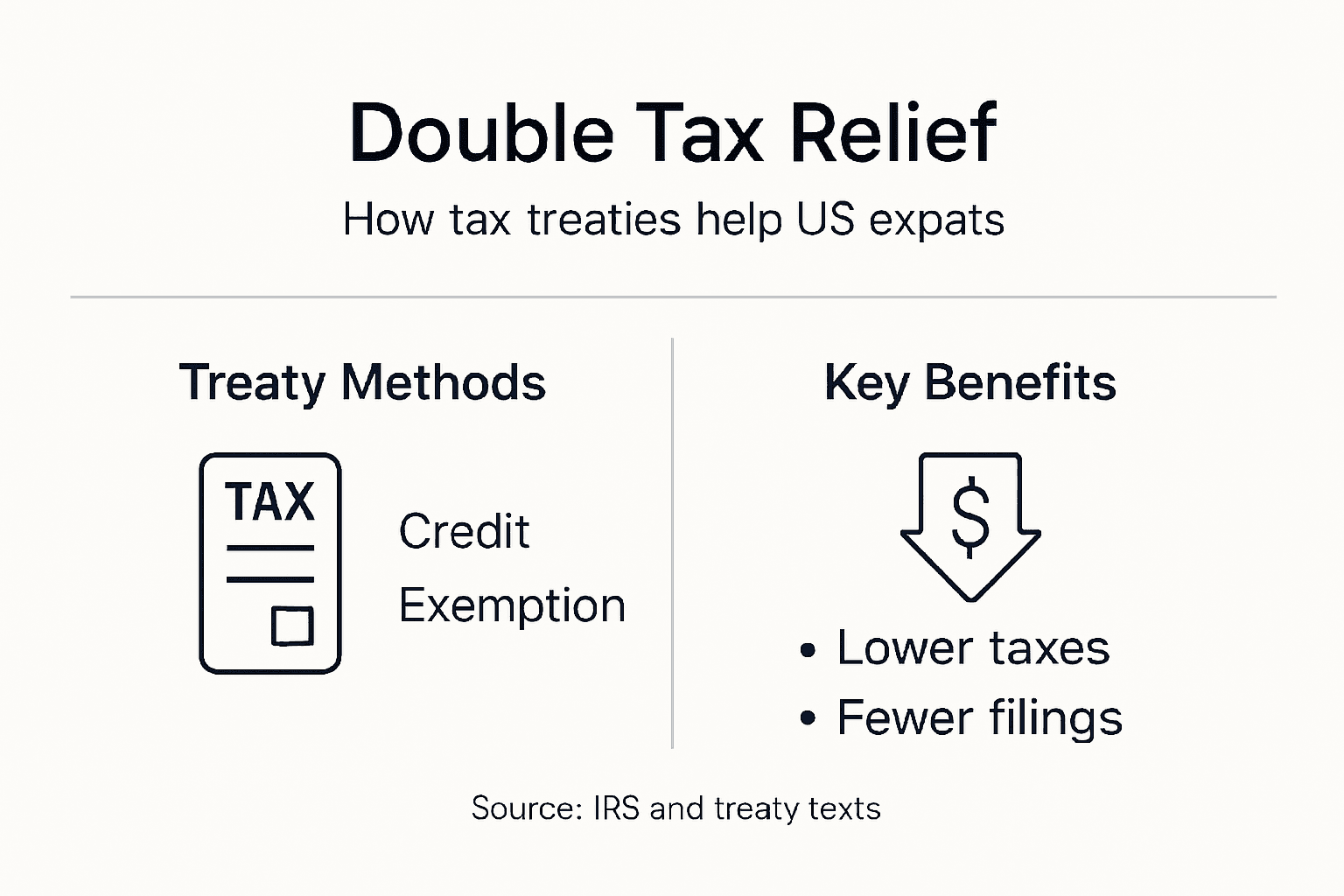
US-European tax treaties provide relief mechanisms through credits, exemptions or reduced withholding rates. Each treaty differs based on negotiated terms between countries. The US maintains comprehensive tax treaties with most Western European nations, though specific provisions vary considerably.
Common treaty provisions by country
Country | Pension taxation | Dividend withholding | Social security |
UK | Source country primary | 15% maximum | Totalization agreement |
Germany | Residence country primary | 15% maximum | Totalization agreement |
France | Residence country primary | 15% maximum | Totalization agreement |
Spain | Source country primary | 15% maximum | Totalization agreement |
Treaties address specific income types through distinct articles. Employment income, business profits, pensions, dividends, interest and royalties each receive separate treatment. Residency tie-breaker rules determine your primary tax home when both countries claim residence, using factors like permanent home location, centre of vital interests and habitual abode.
Understanding treaty mechanics through international tax planning prevents overpayment. Key points include:
Treaties reduce but rarely eliminate all taxation on income
Claiming treaty benefits requires specific forms and documentation
Residency status affects which treaty provisions apply
Some income types receive no treaty protection
Treaty interpretation requires expertise in both US and foreign tax law
Common treaty pitfalls include assuming all income receives preferential treatment or believing treaties automatically apply without proper claims. You must actively invoke treaty provisions on your tax returns, providing required documentation to support your claims.
Common misconceptions about expat taxation
The biggest misconception plaguing American expats centres on foreign tax payments exempting US filing. Paying substantial income tax to France, Germany or the UK creates no exemption from your US filing obligation. US citizenship triggers worldwide income reporting regardless of where you live, work or pay foreign taxes.
This fundamental misunderstanding leads thousands of expats into non-compliance annually. The IRS offers programmes like Streamlined Filing Compliance Procedures for those catching up, but prevention through proper understanding beats remediation every time.
Debunking common myths protects you from costly mistakes:
Myth: Foreign tax payments exempt US filing requirements
Reality: Filing remains mandatory; credits reduce tax owed, not filing obligations
Myth: FBAR only applies to large foreign accounts
Reality: The $10,000 aggregate threshold captures most expats with basic banking
Myth: Tax treaties mean I pay no US tax on foreign income
Reality: Treaties reduce double taxation but rarely eliminate all US tax liability
Myth: The IRS won’t find my foreign accounts
Reality: FATCA requires foreign banks to report US account holders directly to IRS
Another persistent myth suggests working for a US company abroad exempts income from FEIE. The exclusion depends on where you physically perform services, not who employs you. Remote work for US employers from your Barcelona flat qualifies for FEIE if you meet residence or presence tests.
“The most expensive tax advice is the free advice you get from other expats at the pub. What worked for someone in their specific situation may be completely wrong for yours, and the IRS penalises mistakes regardless of how you got the bad advice.”
State tax obligations create another misconception zone. Some expats believe moving abroad automatically severs state tax ties. Many states, particularly those without income tax like Florida or Texas, require explicit steps to abandon domicile. Other states like California or Virginia aggressively pursue former residents for continued tax payments.
Finding and working with cross-border tax professionals
Navigating expat taxation demands specialised expertise spanning US federal tax law, IRS procedures, FinCEN reporting requirements and foreign tax systems. Licensed cross-border tax professionals possess this multijurisdictional knowledge, ensuring your filings satisfy all authorities whilst optimising your tax position.
Generalist accountants familiar only with domestic US taxation often miss critical expat issues. An Enrolled Agent or CPA specialising in expatriate taxation understands FEIE calculations, FTC limitations, treaty provisions and foreign pension characterisation. This specialisation prevents costly errors and identifies planning opportunities domestic practitioners overlook.
Pro Tip: Engage a cross-border professional before relocating to Europe, not after. Advance planning optimises departure year tax treatment, establishes proper foreign entity structures and positions you for maximum FEIE and FTC benefits.
Quality cross-border advisers deliver measurable value through:
Complete IRS, FinCEN and state filing compliance preventing penalties
Optimal FEIE and FTC claiming reducing your overall tax burden
Proper characterisation of foreign pensions, investments and business income
Treaty provision application capturing all available relief
Advance planning for major transactions like home sales or business exits
Linkindependent.com simplifies finding verified professionals through their curated network of licensed advisers. Rather than searching blindly or relying on referrals, their matching process connects you with experts holding proper credentials and specialising in US expat taxation for European residents.
The platform vets advisers for regulatory compliance, relevant experience and transparent fee structures. You receive personalised recommendations matched to your specific situation, whether you need basic filing assistance or sophisticated planning for complex cross-border investments and retirement accounts.
Starting with professional guidance early in your expat journey prevents problems and optimises outcomes. Late engagement often means missed elections, lost planning opportunities or expensive corrections for past filing mistakes. Choosing the right cross-border adviser sets you up for compliant, optimised expat tax management from day one.
Get expert help on your expat taxes with Linkindependent.com
Managing US tax obligations whilst living in Europe demands expertise spanning multiple tax systems and reporting regimes. Linkindependent.com connects you with licensed, vetted cross-border tax professionals who specialise in American expat taxation and understand both US and European requirements.
[

Their expert network provides tailored tax planning, comprehensive filing assistance and strategic advice on optimising your foreign income, pensions and investments. Professional guidance prevents costly IRS and FinCEN penalties whilst identifying legitimate tax savings through proper FEIE, FTC and treaty claims.
Whether you’re newly relocated or a long-term European resident, working with qualified advisers ensures you remain compliant whilst minimising your total tax burden. Access personalised financial advice designed specifically for US expats and start your expat tax compliance journey with trusted professionals today. Making informed decisions with expert support delivers peace of mind and tangible tax optimisation across your international financial life.
Frequently asked questions
What happens if I miss the FBAR filing deadline?
Missing the FBAR deadline triggers penalties starting at $10,000 per violation for non-wilful failures. Wilful violations carry penalties up to the greater of $100,000 or 50 per cent of the account balance. File immediately upon discovering the missed deadline and consider the IRS Streamlined Filing Compliance Procedures if you have multiple unfiled years.
Can I still claim FEIE if I work remotely for a US company in Europe?
Yes, FEIE eligibility depends on where you physically perform services, not your employer’s location. Remote work from your European residence for a US company qualifies for FEIE if you meet the bona fide residence or physical presence test. Maintain clear records documenting your work location and days spent abroad.
How do tax treaties affect my pension payments from Europe?
Treaty treatment varies by country and pension type. Most US-European treaties grant primary taxation rights to your country of residence for private pensions, whilst some give source country priority. Government pensions typically remain taxable only in the paying country. Review your specific treaty provisions and consult a cross-border adviser for proper characterisation.
Is FATCA reporting required if I have only one foreign bank account under £50,000?
FATCA Form 8938 thresholds vary by filing status and residence status. Single filers living abroad must file if foreign assets exceed $200,000 on the last day of the year or $300,000 at any point during the year. Lower thresholds apply to US residents. One account under £50,000 likely doesn’t trigger FATCA, but you may still need FBAR if it exceeded $10,000.
How can a cross-border tax professional help me save on taxes?
Licensed cross-border professionals optimise your tax position through proper FEIE and FTC claiming, strategic timing of income and deductions, correct treaty provision application and efficient structuring of foreign investments and pensions. They identify planning opportunities domestic accountants miss whilst ensuring full compliance with all reporting requirements. Early engagement maximises available strategies and prevents costly mistakes.
Do I need to file US state taxes whilst living in Europe?
State filing obligations depend on whether you properly severed domicile before relocating. Some states like California maintain aggressive nexus rules requiring continued filing even after departure. Other states like Florida or New York demand specific steps to abandon residency. Review your departure state’s rules and document your permanent move to Europe to avoid dual state filing obligations.
Recommended