

Step by Step Financial Consultation for Expats' Success
- Dec 25, 2025
- 8 min read

Most british expats are surprised to learn that over 60 percent face unexpected financial challenges when managing assets across Europe. Balancing international investment risks, cross-border tax rules, and long-term goals often feels complicated for those with global portfolios. This guide shows expats and international investors how careful planning and expert advice can simplify each step, helping you achieve financial security from a british or global perspective.
Table of Contents
Quick Summary
Significant Insight | Description |
1. Define Clear Objectives | Identify your financial aspirations and challenges to create actionable goals tailored to your expat lifestyle. |
2. Organise Financial Documents | Collect and systematise essential documents that support your financial standing for global consultations. |
3. Choose a Regulated Adviser | Select a qualified financial adviser with relevant experience to navigate your international financial needs. |
4. Personalise Tax and Investment Strategies | Develop tailored tax and investment plans that comply with regulations while maximising wealth potential across jurisdictions. |
5. Monitor and Optimise Compliance | Regularly review your financial plan to ensure compliance and effective performance, adapting to any changes in circumstances. |
Step 1: Define Personal Financial Objectives and Challenges
Successful financial planning begins with clearly understanding your unique economic landscape and personal aspirations. In this step, you will develop a comprehensive snapshot of your current financial situation and craft strategic objectives that align with your global lifestyle as an expat.
Starting your financial consultation requires deep self reflection and honest assessment. Financial literacy plays a critical role in shaping personal economic goals, particularly for individuals navigating cross-border financial environments. Consider examining multiple dimensions: your current income streams, existing assets, outstanding debts, risk tolerance, and long-term aspirations. Most expats encounter unique challenges like managing finances across different jurisdictions, understanding complex tax regulations, and maintaining investment strategies that work internationally.
To effectively map your financial objectives, create a structured approach. Begin by listing specific, measurable goals such as retirement savings, property investment, educational funding, or wealth preservation. Categorise these objectives into short-term (1-3 years), medium-term (3-7 years), and long-term (7-20 years) timeframes. This method allows for strategic planning and helps you understand the resources and strategies required to achieve each target.
Professional Tip: Break down complex financial goals into smaller, actionable milestones to maintain motivation and track your progress systematically.
Here is a comparison of common financial objectives for expatriates based on timeframe and suggested initial actions:
Objective Type | Timeframe | Suggested First Action |
Retirement Savings | Long-term (7-20 yrs) | Open suitable pension plan |
Property Investment | Medium-term (3-7 yrs) | Research eligible locations |
Educational Funding | Short-term (1-3 yrs) | Estimate funding requirements |
Wealth Preservation | Ongoing | Consult regulated adviser |
Step 2: Gather Required Financial and Cross-Border Documents
Successful financial consultation requires meticulous document preparation. This critical stage ensures smooth processing of your international financial planning by collecting and organising essential paperwork that demonstrates your financial standing and legal eligibility.

Comprehensive documentation is fundamental for expatriates navigating complex cross-border financial requirements. Your document collection should encompass multiple categories: identification papers, financial statements, tax records, and legal verification documents. Key items include a valid passport with at least 18 months remaining, recent bank statements covering the past six months, proof of current employment or income, tax returns from the previous two years, and any existing investment or retirement account statements. International clients must also prepare translated and notarised documents if they originate from non English speaking countries.
Organise your documents systematically using both digital and physical storage methods. Create a dedicated folder separating documents by category: personal identification, financial records, tax documents, and legal certificates. Scan high quality copies and store them securely in encrypted digital formats while maintaining original hardcopies in a safe location. Ensure all documents are current, legible, and accurately represent your financial profile across different jurisdictions.
Professional Tip: Create a comprehensive document checklist and cross reference it with your financial adviser to ensure no critical paperwork is overlooked during your consultation.
Step 3: Select a Regulated Global Financial Adviser
Choosing the right financial adviser represents a pivotal moment in your international wealth management journey. This crucial step determines the quality and effectiveness of your financial strategy, ensuring you receive expert guidance tailored to your unique cross-border financial landscape.
Navigating the complex world of global financial advice requires careful evaluation. Selecting regulated financial advisers offers critical protection for international investors, ensuring professional standards and legal accountability. When assessing potential advisers, prioritise several key criteria: professional credentials, regulatory compliance, international experience, language capabilities, and specialisation in expat financial services. Look for advisers registered with recognised financial authorities such as the Financial Conduct Authority in the United Kingdom, the Securities and Exchange Commission in the United States, or equivalent regulatory bodies in your target countries.
During your selection process, conduct comprehensive interviews and request detailed information about the adviser’s background, fee structures, investment philosophies, and track record with international clients. Request references from expatriates with similar financial profiles, review their professional certifications, and verify their regulatory status through official professional registers. Pay particular attention to advisers who demonstrate expertise in cross border taxation, international investment strategies, and comprehensive wealth management approaches specific to global professionals.
Professional Tip: Always request a preliminary consultation to assess the adviser’s communication style and understanding of your unique financial challenges before making a final commitment.
Step 4: Develop Tailored Tax and Investment Strategies
Developing personalised tax and investment strategies forms the cornerstone of successful international financial planning. This critical phase translates your financial objectives into actionable, legally compliant approaches that maximise your wealth potential across multiple jurisdictions.
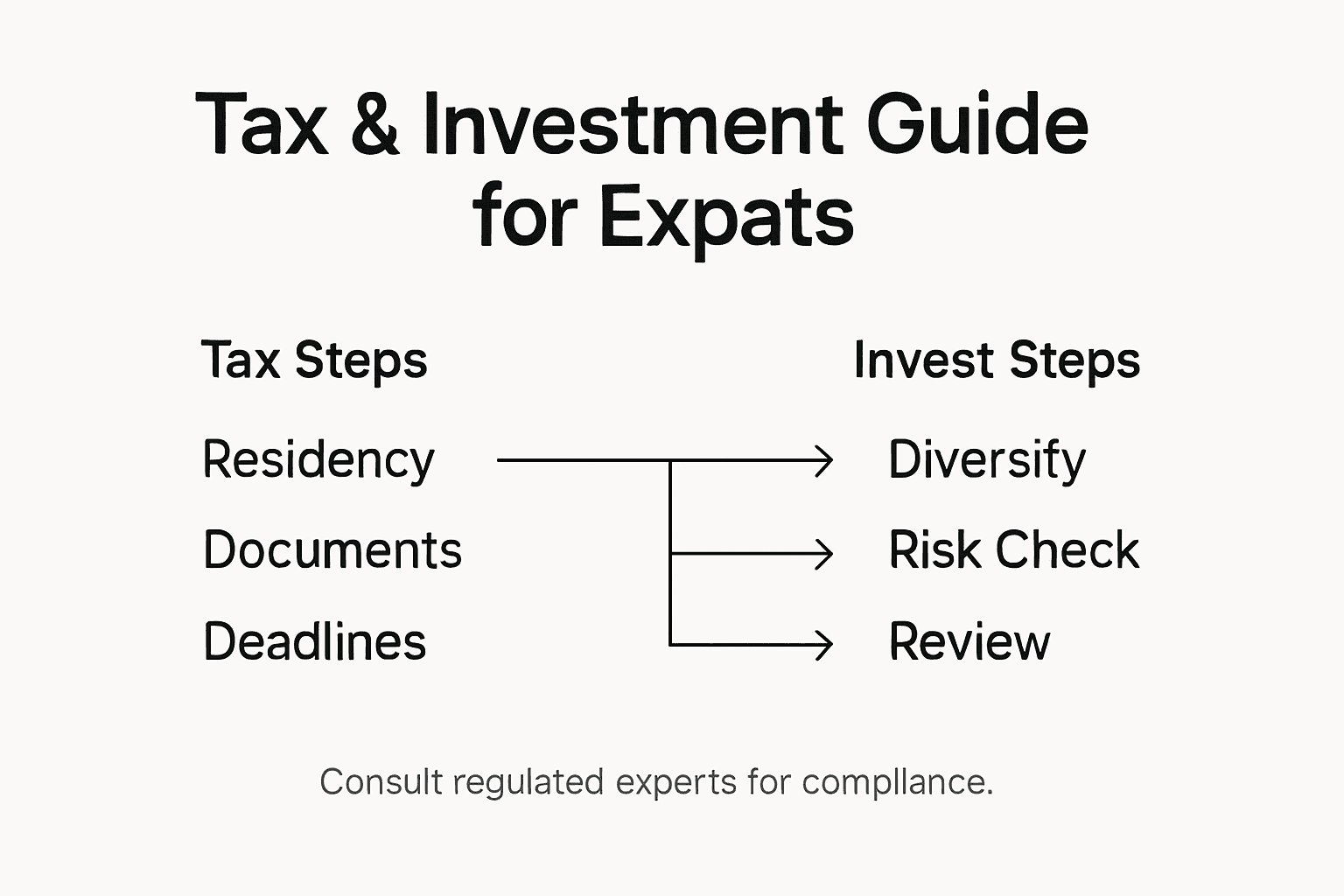
Creating a robust financial strategy requires comprehensive analysis and strategic thinking. Global wealth planning demands nuanced approaches that adapt to complex international financial landscapes, particularly for expatriates managing assets across different countries. Your strategy should incorporate multiple key considerations: tax efficiency, risk management, investment diversification, currency fluctuation protection, and compliance with international financial regulations. Begin by mapping your current financial assets, understanding the tax implications in your home and host countries, and identifying potential opportunities for tax optimisation through legal investment vehicles such as offshore trusts, international pension schemes, and strategic asset allocation.
Implement a dynamic investment approach that balances growth potential with risk mitigation. Consult with your financial adviser to develop a personalised investment portfolio that reflects your risk tolerance, financial goals, and international mobility. Consider investment instruments that offer flexibility and tax advantages such as globally diversified index funds, exchange traded funds, international bonds, and tax efficient retirement planning vehicles. Regularly review and adjust your strategy to accommodate changing personal circumstances, international tax laws, and global economic shifts.
Professional Tip: Maintain detailed documentation of all international financial transactions and consult with tax professionals in relevant jurisdictions to ensure full compliance and optimal tax positioning.
Step 5: Verify Plan Compliance and Optimise Outcomes
The final stage of your financial consultation involves rigorous verification and strategic refinement of your carefully constructed international financial plan. This crucial phase ensures that your wealth management strategy remains legally sound, financially robust, and aligned with your evolving personal and professional objectives.
Securing global financial futures requires meticulous attention to regulatory compliance and performance optimisation, particularly for expatriates navigating complex international financial environments. Initiate a comprehensive review process involving detailed audits of your investment portfolio, tax structures, and risk management strategies. Work closely with your financial adviser to conduct thorough compliance checks across multiple jurisdictions, verifying that your financial plan adheres to all relevant legal and tax regulations. This involves examining documentation, cross referencing investment strategies with current international financial laws, and ensuring full transparency in all financial transactions.
Implement a proactive approach to performance monitoring and continuous improvement. Schedule quarterly review sessions with your financial adviser to assess the performance of your investment portfolio, analyse market trends, and make data driven adjustments. Develop key performance indicators that measure the effectiveness of your financial strategy, tracking metrics such as investment returns, tax efficiency, risk mitigation, and alignment with your long term financial goals. Be prepared to pivot and adapt your strategy in response to changing personal circumstances, shifts in global economic conditions, or modifications in international financial regulations.
Professional Tip: Create a digital dashboard or spreadsheet to track your financial performance metrics, enabling real time monitoring and quick strategic adjustments.
Below is a summary of essential performance metrics for international financial plans:
Metric | Purpose | Example Measurement |
Investment Return | Assess portfolio growth | Annual percentage increase |
Tax Efficiency | Evaluate tax burden minimisation | Reduction in withholding tax |
Risk Mitigation | Identify exposure levels | Portfolio volatility index |
Goal Alignment | Track progress towards objectives | Percentage of target achieved |
Secure Your Expat Financial Success with Trusted Global Experts
Navigating the complexities of international finance requires more than just knowledge it demands access to regulated, experienced professionals who truly understand your unique challenges. Whether you are defining personal financial objectives, gathering cross-border documentation, or crafting tax and investment strategies the critical step is finding advisers who can guide you seamlessly across jurisdictions with transparency and expertise. This is exactly what you gain with Linkindependent.com.

Take control of your global wealth journey now by connecting with verified financial advisers, tax specialists, and legal experts dedicated to expat success. Benefit from a personalised, straightforward matching process and free consultations tailored to your goals. Don’t wait until regulatory complexities or investment risks grow avoidable pitfalls start your path to confident financial planning today at Linkindependent.com. Explore how our platform simplifies international wealth management and puts trusted guidance within your reach.
Frequently Asked Questions
What are the key steps in the financial consultation process for expats?
The financial consultation process for expats involves five key steps: defining personal financial objectives, gathering required documents, selecting a regulated financial adviser, developing tailored tax and investment strategies, and verifying plan compliance to optimise outcomes. Begin by assessing your unique financial situation and goals to create a roadmap for your financial planning journey.
How can I set measurable financial goals as an expatriate?
To set measurable financial goals, categorise them into short-term, medium-term, and long-term timeframes, and specify the desired outcomes for each. For example, you might aim to save for retirement over the next 20 years while planning to purchase property in the next 5 years. Write down these goals to track your progress effectively.
What documents do I need to prepare for my financial consultation?
Prepare essential documents such as identification papers, recent bank statements, tax records, and proof of income. Create a checklist of these items to ensure that you have everything needed, and aim to complete this preparation within 30 days before your consultation.
How do I choose the right financial adviser for my situation as an expat?
To choose the right financial adviser, evaluate their professional credentials, regulatory compliance, and experience with international clients. Schedule preliminary consultations with potential advisers to assess their understanding of your needs and to gather more information on their fees and investment philosophies.
What elements should my tax and investment strategies include as an expat?
Your tax and investment strategies should account for tax efficiency, risk management, investment diversification, and compliance with international regulations. Work closely with your adviser to develop a personalised strategy that includes these elements and regularly review it to adapt to changing circumstances.
How often should I review my financial plan to ensure its effectiveness?
Regularly review your financial plan at least every six months to ensure it aligns with your evolving goals and market conditions. Schedule quarterly check-ins with your adviser to monitor performance and adjust your strategy as needed.
Recommended
Comments