

Expat Tax Planning – How It Shapes Your Move Abroad
- Feb 16
- 7 min read

Retiring to France or Spain sounds idyllic until tax rules complicate your financial peace of mind. For American expatriates, the need to report worldwide income—even after relocation—creates a maze few expect. Understanding citizenship-based taxation requirements and how they impact 401k distributions and international assets is vital for avoiding costly missteps. This guide offers clear strategies and expert insights tailored to help you manage your retirement finances across borders with confidence.
Table of Contents
Key Takeaways
Point | Details |
Expat Tax Planning Is Essential | U.S. citizens living abroad must navigate complex tax obligations, including worldwide income reporting, necessitating strategic tax planning. |
Double Taxation Risks | U.S. expatriates face potential double taxation; understanding tax treaties can provide critical relief to mitigate these financial burdens. |
Compliance Obligations Are Complex | Expatriates must adhere to stringent compliance requirements, including FBAR and FATCA, to avoid severe penalties. |
Professional Guidance Is Recommended | Consulting a cross-border tax specialist is crucial for navigating the intricacies of U.S. and international tax laws effectively. |
What Is Expat Tax Planning?
Expat tax planning is a comprehensive financial strategy designed to help U.S. citizens understand and manage their tax obligations while living overseas. At its core, this process involves navigating the complex landscape of international taxation, ensuring compliance with U.S. tax laws while minimising potential financial liabilities.
The fundamental challenge stems from the United States’ unique citizenship-based taxation system, which requires citizens to report worldwide income regardless of their country of residence. This means that even if you’re living and earning income in another country, you’re still required to file U.S. tax returns and potentially pay taxes to the American government. Citizenship-based taxation requirements create a distinctive set of challenges for expatriates.
Key aspects of expat tax planning typically include:
Understanding foreign earned income exclusion rules
Calculating potential foreign tax credits
Identifying tax treaty benefits
Managing international investment reporting requirements
Navigating potential double taxation scenarios
Unlike most countries that employ residence-based taxation, the U.S. system mandates that citizens report all global income. This complexity necessitates strategic financial planning to ensure legal compliance and optimise tax efficiency. Proposed reforms like residence-based taxation could potentially simplify this process, potentially transforming expatriate tax regulations.
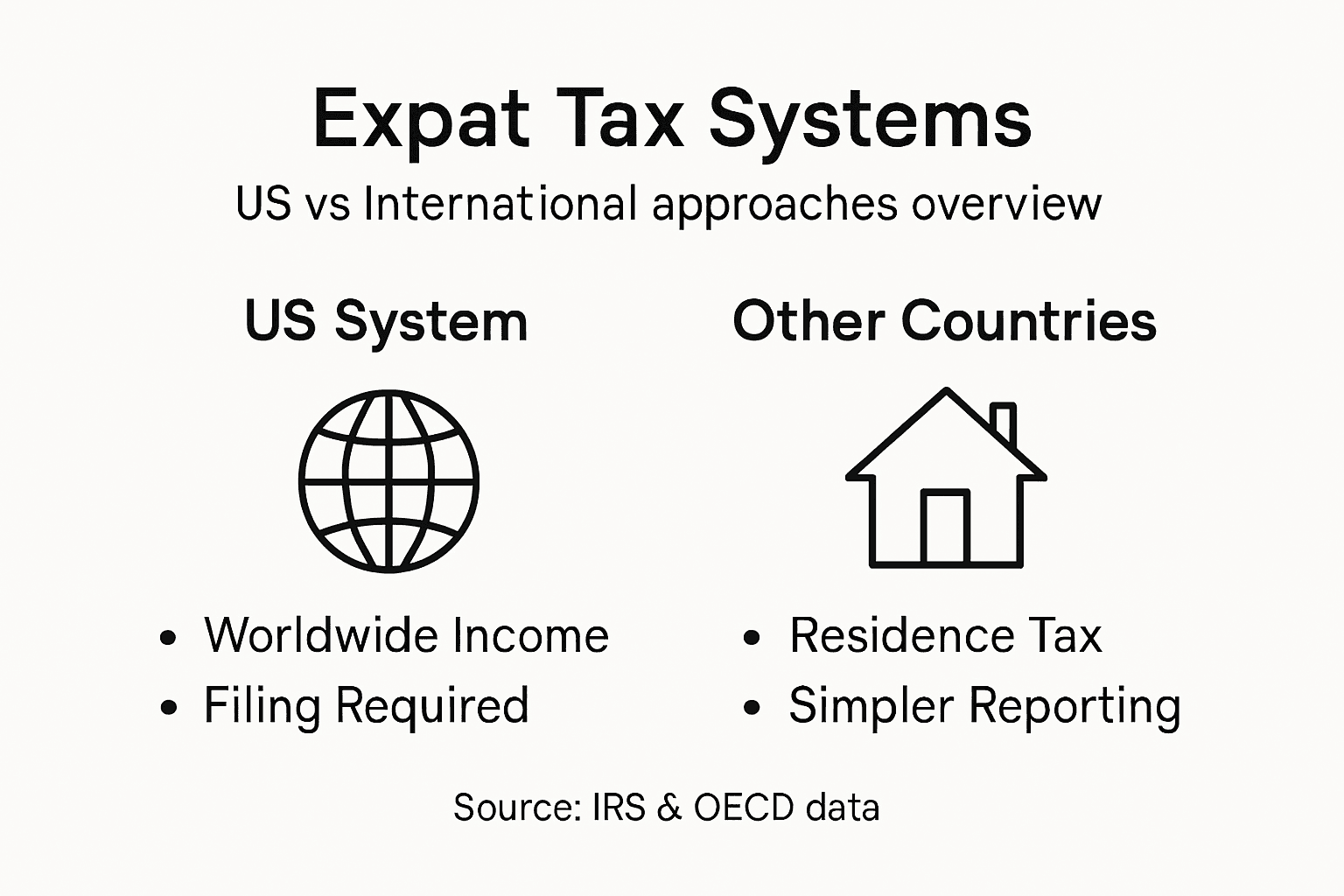
To better understand the unique challenges faced by U.S. expatriates, here is a comparison of citizenship-based and residence-based taxation systems:
Tax System | Who Must File Taxes | International Reporting Complexity | Impact on Expats |
Citizenship-based | All citizens, regardless of location | High; global income disclosure required | Greater administrative burden |
Residence-based | Residents only, not citizens abroad | Moderate; mainly local income tracked | Often simpler for expatriates |
Pro tip: Consult a cross-border tax specialist who understands both U.S. and your current country’s tax regulations to develop a comprehensive expat tax strategy.
Key Tax Challenges for US Expats
U.S. expatriates face a labyrinth of complex tax challenges that extend far beyond typical domestic filing requirements. The fundamental complexity arises from the United States’ distinctive citizenship-based taxation system, which mandates that citizens report worldwide income regardless of their geographical location. Key reporting obligations create significant administrative burdens for those living abroad.
The most pressing tax challenges for U.S. expats encompass multiple intricate dimensions:
Complying with worldwide income reporting requirements
Navigating foreign earned income exclusion regulations
Managing potential double taxation scenarios
Meeting stringent foreign bank account reporting (FBAR) requirements
Understanding complex international tax treaty provisions
Maintaining compliance with both U.S. and local tax jurisdictions
Moreover, international tax compliance complexities present substantial risks. Failure to file required documentation or misunderstanding reporting deadlines can result in significant financial penalties. The Foreign Bank Account Report (FBAR) and Foreign Account Tax Compliance Act (FATCA) impose additional layers of complexity, requiring meticulous documentation of all foreign financial accounts.
The financial landscape for U.S. expatriates is further complicated by the potential for substantial penalties. Missed filings, incomplete reporting, or incorrect tax calculations can trigger severe consequences, including substantial monetary fines and potential legal complications. Expats must remain vigilant, proactively managing their tax obligations to mitigate these risks.

Pro tip: Maintain a comprehensive digital filing system for all international financial documents and consider working with a cross-border tax specialist who understands both U.S. and your current country’s specific tax regulations.
Double Taxation and Treaty Relief Explained
Double taxation represents a significant financial challenge for U.S. expatriates, occurring when the same income is subjected to taxation by multiple jurisdictions. Tax treaty mechanisms provide critical relief, establishing clear protocols for preventing duplicate tax liabilities across international borders.
The key components of double taxation relief include:
Defining precise residency status for tax purposes
Allocating taxing rights between countries
Establishing mechanisms for tax credit calculations
Limiting withholding tax rates on specific income types
Creating standardised dispute resolution processes
Preventing tax evasion through transparent reporting requirements
International tax treaties typically follow standardised frameworks developed by organisations like the OECD and United Nations. Cross-border taxation principles aim to create predictable environments that encourage cross-border investments while protecting each nation’s fiscal interests. These agreements typically address complex scenarios involving business profits, passive income, and capital gains.
The practical implications of these treaties are profound. They can significantly reduce an expatriate’s overall tax burden by preventing duplicate taxation, offering foreign tax credits, and establishing clear guidelines for income reporting. Understanding these nuanced agreements requires sophisticated financial planning and often necessitates professional guidance to navigate effectively.
Pro tip: Consult a specialised cross-border tax professional who can interpret treaty provisions specific to your individual financial situation and country of residence.
Managing 401k Distributions and International Assets
Navigating 401k distributions while living abroad represents a complex financial challenge for U.S. expatriates. The intricacies of international retirement planning demand meticulous attention to both U.S. Internal Revenue Service (IRS) regulations and local tax jurisdictions. Foreign pension distribution rules create a nuanced landscape that requires sophisticated financial strategy.
Critical considerations for managing 401k distributions internationally include:
Understanding required minimum distribution (RMD) obligations
Assessing potential tax treaty implications
Evaluating withholding tax requirements
Tracking cross-border reporting responsibilities
Calculating potential double taxation scenarios
Managing currency exchange rate impacts on distributions
The technical complexities surrounding retirement plan compliance are substantial. Expats must navigate multiple regulatory frameworks, ensuring that their retirement assets remain protected while adhering to both U.S. and international financial regulations. This often requires strategic timing of distributions, comprehensive documentation, and potentially restructuring investment portfolios to optimise tax efficiency.
Potential pitfalls are significant for those who do not carefully manage their international asset distributions. Incorrect reporting, missed filing deadlines, or misunderstanding treaty provisions can result in substantial penalties, unexpected tax liabilities, and potential legal complications. Professional guidance becomes essential in interpreting the intricate interplay between U.S. retirement regulations and international financial systems.
Pro tip: Maintain a comprehensive digital archive of all international financial documents and consult a cross-border financial specialist who specialises in U.S. expatriate retirement planning.
Essential Compliance and Reporting Obligations
Navigating the complex landscape of international tax compliance demands meticulous attention to multiple reporting requirements for U.S. expatriates. Expat reporting obligations create a sophisticated administrative framework that extends far beyond traditional domestic tax filing.
Key compliance requirements for U.S. expatriates include:
Filing annual U.S. tax returns
Submitting Foreign Bank Account Report (FBAR)
Disclosing foreign assets under FATCA regulations
Maintaining comprehensive financial documentation
Tracking cross-border financial transactions
Managing electronic reporting deadlines
The international tax ecosystem has become increasingly complex, with regulatory bodies implementing stringent transparency measures. Global reporting standards now require detailed documentation of global income distributions, tax payments, and economic activities across different jurisdictions. This multilayered approach aims to prevent tax evasion and ensure comprehensive financial transparency.
Non-compliance can result in severe consequences, including substantial financial penalties, potential legal complications, and increased scrutiny from tax authorities. The intricate nature of these reporting obligations necessitates a proactive approach, often requiring specialised professional guidance to navigate the nuanced international tax landscape effectively.
The following summary outlines key international tax reporting forms, their purpose, and potential penalties for non-compliance:
Reporting Form | Purpose | Potential Penalties |
U.S. Tax Return (Form 1040) | Disclose worldwide annual income | Fines, criminal charges |
FBAR (FinCEN 114) | Report foreign bank accounts | $10,000+ fines per violation |
FATCA (Form 8938) | Declare specified foreign assets | Up to $50,000 penalties |
Local Country Return | Meet host nation tax obligations | Local jurisdiction penalties |
Pro tip: Establish a systematic digital record-keeping process and consider consulting a cross-border tax specialist who understands the intricate reporting requirements for U.S. expatriates.
Master Your Expat Tax Planning with Trusted Experts
Facing the complexities of U.S. citizenship-based taxation while living abroad can be overwhelming. From navigating foreign earned income exclusions to managing 401k distributions and avoiding double taxation, the challenges require specialised knowledge and precise planning. If you want to protect your assets and ensure full compliance without the stress, expert support is essential.

Discover how Linkindependent.com connects you with verified, regulated financial and tax professionals experienced in cross-border expatriate issues. Our platform simplifies your search for advisers who understand U.S. expatriate tax obligations and can tailor strategies to your unique situation. Don’t wait for penalties or confusion—take control of your international finances today by visiting Linkindependent.com and start your free consultation. Expert guidance is just a few clicks away.
Frequently Asked Questions
What is expat tax planning?
Expat tax planning is a financial strategy that helps U.S. citizens living abroad understand and manage their tax obligations. It involves navigating international taxation and ensuring compliance with U.S. tax laws while minimising potential financial liabilities.
How does citizenship-based taxation affect U.S. expatriates?
Citizenship-based taxation requires U.S. citizens to report their worldwide income, regardless of their location. This means expatriates must file U.S. tax returns and may owe taxes to the American government even if they are paying taxes in another country.
What are the key challenges faced by U.S. expatriates regarding taxes?
U.S. expatriates encounter challenges such as complying with worldwide income reporting, managing double taxation scenarios, navigating foreign earned income exclusion regulations, and meeting stringent foreign bank account reporting requirements.
How can double taxation relief benefit U.S. expatriates?
Double taxation relief can prevent the same income from being taxed in multiple jurisdictions, reducing an expatriate’s overall tax burden. Tax treaties facilitate this by providing credits and establishing clear guidelines for income reporting.
Recommended
Comments